

Post-Concussion Syndrome Treatment for Symptoms That Are Still Here Months or Years Later
Your symptoms are real, and you are not out of options. Cognitive FX, an outpatient clinic in Provo, Utah, treats adults whose concussion symptoms have lasted three months or longer, with one or two weeks of intensive therapy planned from a functional MRI scan.
Free · about 10 minutes · from home · reviewed by our clinical team. See program facts and prices.
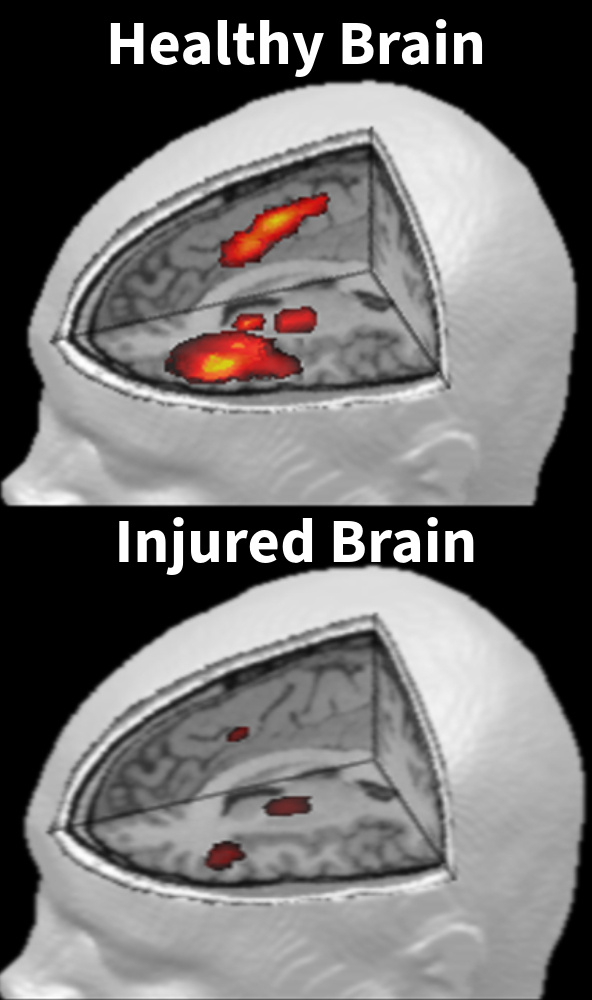
Functional MRI activation: a healthy pattern next to a post‑concussion patient. A standard structural MRI often looks normal in both.
Post-concussion syndrome treatment at Cognitive FX in Provo, Utah: the facts
Medically reviewed by Lynn M. Gaufin, MD, Director of Neurosurgery. Last reviewed October 12, 2026.
- Who it is for
- Adults whose concussion or mild TBI symptoms have lasted three months or longer and still limit work, school, or daily life after standard care.
- Where
- 280 W River Park Drive, Suite 110, Provo, Utah 84604. Patients travel from across the U.S. and abroad; Provo Airport is 15 minutes away.
- What treatment is
- EPIC: a functional MRI scan (fNCI), then a week of cognitive, physical, occupational, vestibular, and vision therapy in one building, sequenced by the scan. A second scan at the end of the week measures what changed.
- How long
- One week, or two weeks for complex or long‑standing cases. Treatment days run about 9 to 5 with rest breaks built in.
- Cost
- $13,000 for one week; $24,700 for two weeks. A stand‑alone fNCI scan is $1,500, credited toward EPIC if you continue.
- Insurance
- Out‑of‑network. We provide a superbill after treatment; reimbursement varies by plan and is not guaranteed.
- Wait time
- Typically about six weeks from an accepted case review to your treatment week.
- Evidence
- In an independent study by Amsterdam UMC and UMC Groningen, 77% of the patients measured six months after treatment had a clinically meaningful reduction in symptoms. Observational, not randomized. Individual results vary.
- First step
- A free 10‑minute case review from home, before anyone books travel.
Free, about 10 minutes, from home. Our clinical team reviews every answer.
Who should I see for concussion symptoms that won’t go away?
Start with your primary care doctor or a sports medicine physician who treats concussion. If symptoms suddenly get worse, or you have a headache that keeps getting worse, repeated vomiting, a seizure, slurred speech, unusual drowsiness or confusion, or new weakness or numbness, go to an emergency room. For symptoms that linger past a few weeks, the usual path is a series of referrals:
The usual path
- Primary care
- Neurologist
- Vestibular physical therapist
- Neuropsychologist
- Neuro‑optometrist
- Mental health provider
Different offices. Usually one or two visits a week. No shared plan.
An intensive program at Cognitive FX
fNCI scanOne plan for the whole team
- Cognitive therapy
- Physical therapy
- Occupational therapy
- Vestibular therapy
- Vision therapy
One building. Full days for 1 or 2 weeks. Daily progress review.
Each of those specialists can help with one piece. They usually work in different offices, see you once or twice a week, and do not share one plan. Two of the patients quoted below lived with symptoms for a year and a half and for 13 years before they found us.
“Sleep it off. Maybe in a year, you’ll be better.”
What doctors told an eighth‑grader with persistent symptoms, before her family found us.“You just like to be taken care of. You’ll get better when you want to.”
What a doctor told a mother who had lived with post‑concussion symptoms for 13 years.“Why couldn’t anyone provide this critical information during the past 1.5 years?”
Silvie van de Ree, writing in an independent review after a year and a half undiagnosed.
How is intensive treatment different from weekly concussion therapy?
If you have already been through the referral loop and you are still stuck, Cognitive FX puts those disciplines in one building, on one plan, for one concentrated week.
-
One plan from one scan
Before treatment, an fNCI functional MRI measures activity in 56 brain regions while you do cognitive tasks. Every therapist on your team works from the same results, so vestibular, vision, cognitive, and physical work target the same systems.
-
A week of therapy instead of months of appointments
At home, one or two therapy sessions a week is often the ceiling. Here, you get full days of therapy with structured rest, delivered by a multidisciplinary team, with a review of your progress at the end of each day.
-
Prices and research you can check before you call
Our prices are published on this page. Our outcomes were studied by independent university researchers, and our scan method is published in peer‑reviewed literature.
How do post-concussion treatment options compare?
| Hospital concussion clinic | Weekly local therapy | Intensive program at Cognitive FX | |
|---|---|---|---|
| Often best for | Recent and sports‑related concussions; diagnosis and return‑to‑play plans | One or two main symptoms, such as dizziness or neck pain | Symptoms lasting 3+ months across several systems after standard care |
| Schedule | Appointments spread over weeks or months | 1 to 2 sessions a week | Full treatment days for 1 or 2 weeks, then a home program |
| Coordination | Varies by program | Each provider works separately | One team, one scan‑based plan, daily progress review |
| Insurance | Usually billed to insurance | Usually billed to insurance | Out‑of‑network; superbill provided |
| Cost to you | Copays and deductibles | Copays per visit | $13,000 for one week; $24,700 for two |
General comparison; programs vary. Ask any clinic about its schedule, team, and costs before you commit.
Who is a good candidate for post-concussion treatment at Cognitive FX?
Every application goes through a case review before anyone books travel. The most common reasons we say no: the injury is too recent, or a single injury with limited symptoms that is likely to resolve with local care and time. We would rather tell you no from your living room than take your money in Provo.
- Concussion or mTBI 3+ months ago, symptoms still limiting your life
- Brain fog, fatigue, headaches, screen intolerance, overwhelm in busy places
- Standard care tried: rest, meds, weekly PT, and it was not enough
- “Scan was normal” but you know something is wrong
- Under 3 months post‑injury: start with local vestibular or physical therapy first; many people recover with time and graded activity
- A single injury with limited symptoms: likely to resolve with local care; we screen these out at the case review
- Unstable medical or psychiatric conditions that need treatment first
How does post-concussion syndrome treatment at Cognitive FX work?
A standard MRI looks at brain structure. Our functional imaging measures activation while your brain performs cognitive tasks, giving the clinical team more information to personalize treatment.
- From homeFree case reviewAbout 10 minutes. Our clinical team reviews your history and gives you a straight answer.
- About 6 weeksWait for your weekTypical time from an accepted case review to your treatment week.
- Day beforeFly inProvo Airport is 15 minutes from the clinic; Salt Lake City is 45.
- Day 0fNCI scan56 brain regions measured; results reviewed with you the same day.
How the scan works - Days 1 to 4Full days of therapyAbout 9 to 5, sequenced by your scan, rest built in.
What the week looks like - Day 5Re‑scan and home planA second scan measures what changed. Fly home the next day.
- Next 2 to 3 monthsHome programScheduled video follow‑ups with our team.
What happens after
Does intensive post-concussion treatment work?
Independent researchers studied our patients and published the results.
of patients measured six months after treatment had a clinically meaningful reduction in symptoms, in an independent study.
Each dot is one of the 52 patients measured six months after treatment. The 40 blue dots had meaningfully fewer symptoms.
Independent Dutch university study (Amsterdam UMC and UMC Groningen), measured on the SCAT5 before treatment and at follow‑ups up to six months. Observational study; not randomized. Individual results vary.
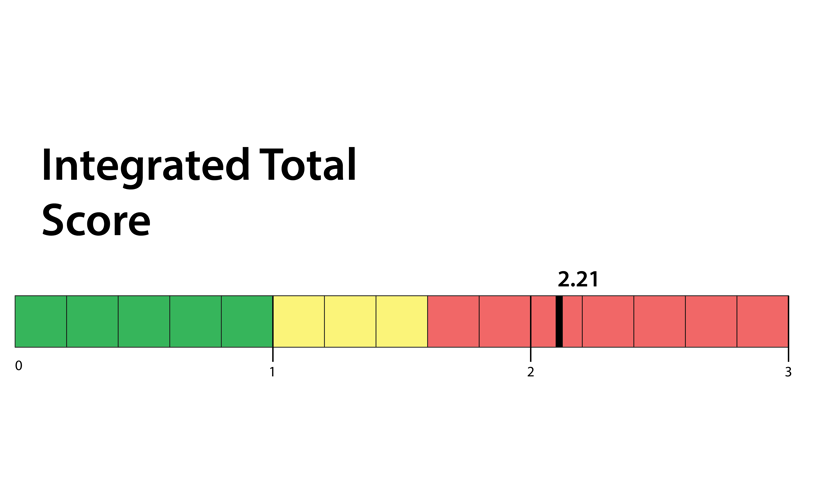 After the treatment week
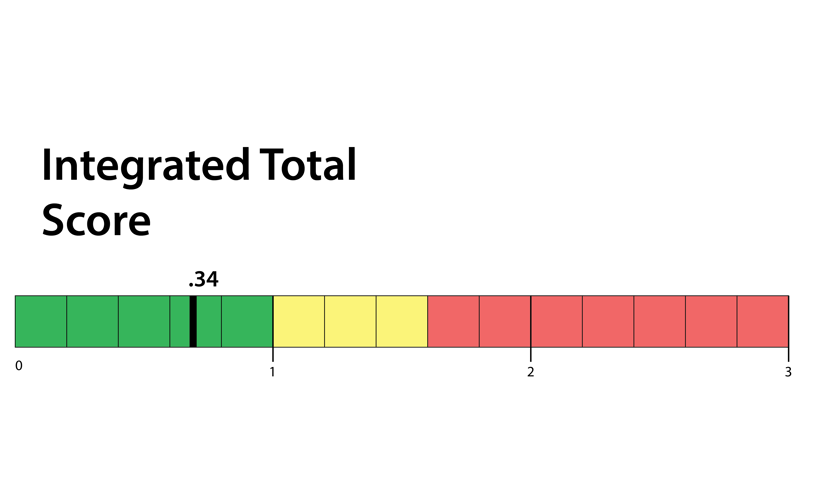
One patient’s fNCI severity index before and after treatment. Lower is better: green is the typical range, red is well outside it. Individual results vary.
See study details and limitations
The study was run by independent researchers at Amsterdam UMC and UMC Groningen and published as van Doorn et al., Tijdschrift voor Neuropsychologie, 2024. It was not authored or funded by Cognitive FX. The team enrolled 64 patients and measured them before treatment and one week, one month, and six months after, using validated instruments; group‑level gains held at six months. Because the study had no control group, it cannot fully separate treatment effects from other causes of improvement.
Method paper: Wing et al., The Open Neuroimaging Journal, 2017 (270 patients). All research: all of our published research
What our own published data shows
These two results come from Cognitive FX’s own retrospective study, written by our team and published in Brain Disorders & Therapy (Epps et al., 2019). It was not independent and had no randomized control group. We include it because it is our largest dataset.
The average symptom score fell by more than half during the treatment week.
Post-Concussion Symptom Scale (PCSS), scored 0 to 132; lower is better. Measured at the end of the week, not months later. Individual results vary.
About 9 months of usual care barely moved their scan scores. One treatment week did.
fNCI severity index from our functional MRI scan; lower is better. Usual care averaged 264 days; the EPIC period averaged 18 days. Small sample. Individual results vary.
How to read our own studies
In the 375-patient group, the average PCSS fell from 33.5 to 14.9 and the average fNCI severity index fell from 2.77 to 0.46. In a second group of 43 patients who were scanned before and after both usual care and EPIC, EPIC lowered the severity index far more than usual care did, whichever came first. The 28 patients who had EPIC first kept improving during the usual care that followed.
Limits: these are retrospective chart reviews by Cognitive FX authors, the severity index comes from our own scan, and symptom scores were measured right after treatment. The independent Dutch study above is the stronger evidence on how results hold at six months. Source: Epps CT, Johnson ML, Fong AK, Allen MD. Brain Disorders & Therapy 8:255, 2019.
Sources
- van Doorn et al. Cognitive FX treatment for persistent complaints after concussion. Tijdschrift voor Neuropsychologie, 2024. Read the paper
- Epps CT, Johnson ML, Fong AK, Allen MD. Brain Disorders & Therapy 8:255, 2019. Read the paper
- Wing et al. The Open Neuroimaging Journal, 2017.
- Patricios et al. Consensus statement on concussion in sport (Amsterdam 2022). British Journal of Sports Medicine, 2023. PubMed
What does the fNCI functional MRI scan show?
fNCI is a functional MRI protocol that measures activity across 56 brain regions while you perform cognitive tasks inside the scanner, then compares your pattern to a normative database. You sit down with a clinician and see, region by region, what is underperforming and what is overcompensating.
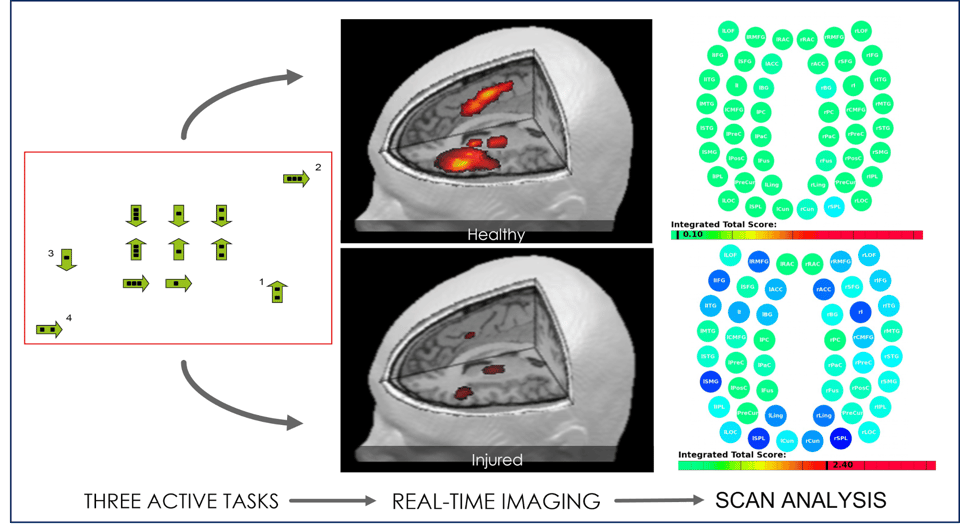
How the scan works: cognitive tasks in the scanner, real‑time imaging, then analysis against a normative database.
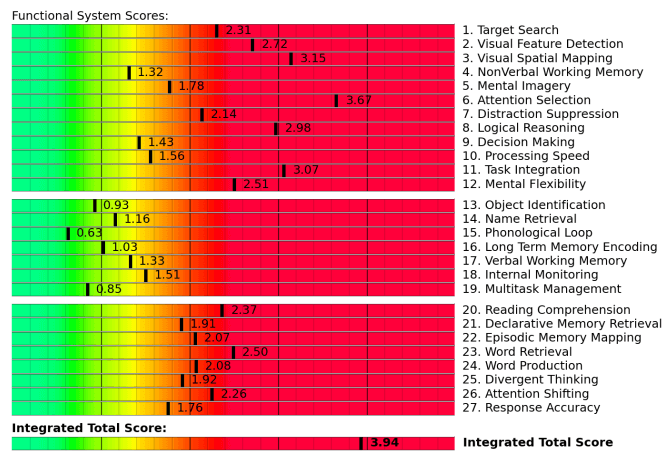
What you get: a report scoring each functional system. This is what your own results will look like.
Explore an interactive 3D model of what an fNCI scan shows Rotate the brain and see which regions are under‑ or over‑active.
More about the fNCI scan and how it is analyzed
Why do symptoms persist when a standard MRI looks clean?
A standard MRI shows your brain’s structure, and after a concussion the structure usually looks fine. But a concussion can disrupt neurovascular coupling: the signaling that delivers blood and oxygen to brain regions in the moment they are working. When a region starts working, nearby vessels are supposed to dilate within about a second to deliver extra oxygen and glucose. Research on persistent post‑concussion symptoms points to this regulation staying dysregulated in specific regions: the region is intact, but it is running on an unreliable fuel line. Tasks that used to be effortless, like reading, screens, or a noisy room, now drain the system and trigger symptoms. Because brain structure usually looks normal, a structural MRI often reads as normal.
Is fNCI a diagnosis?
No. fNCI is not a stand-alone diagnosis; we use many different data points to assess the severity of an injury. fNCI is a measurement tool: it maps which of your brain’s functional systems are working inefficiently so therapy can be aimed at those systems instead of guessing. The method behind it is published in peer‑reviewed literature (Wing et al., The Open Neuroimaging Journal, 2017, based on 270 concussion patients).
What happens during the treatment week?
EPIC is an intensive week of established rehabilitation therapies: physical, cognitive, occupational, vestibular, and vision therapy, delivered by a multidisciplinary team in one building, sequenced by what your scan showed.
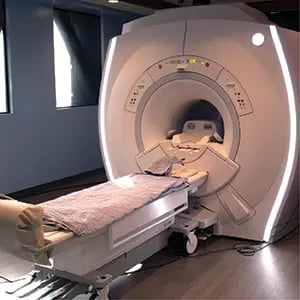
Your fNCI scan
Scan in the morning. Results reviewed with you the same day. Your treatment plan is built from it.
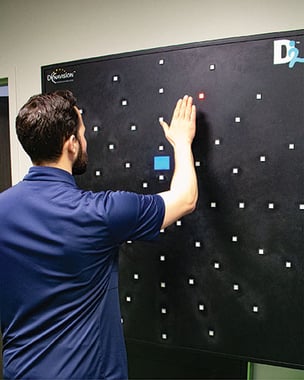
Full days of targeted therapy
Rotations of cognitive, physical, occupational, and vestibular work with rest built in. Hard by design.
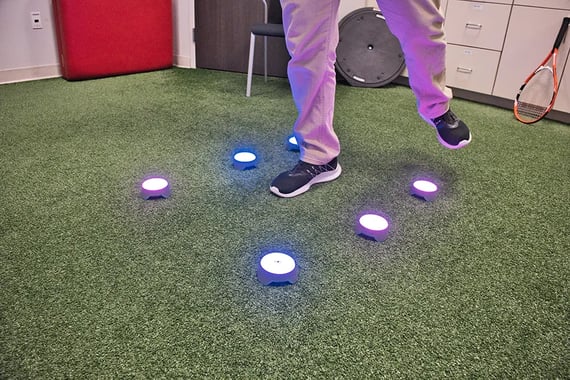
Re-scan and home plan
A second fNCI measures what changed. You leave with a home program and scheduled follow‑ups.
Sample treatment, 9 to 5
Illustrative sample day. Your actual schedule is sequenced from your scan and paced to what you can tolerate.
Which therapies are part of the EPIC week?
Each day rotates through these disciplines, adapted to your scan results and your symptoms.
- Cognitive therapy
- Sessions with speech‑language pathologists that work on short‑ and long‑term memory, attention, and executive function.
- Occupational and vision therapy
- Tasks that combine vision with balance, attention, memory, word recall, and motor skills, to improve eye movements such as saccades, pursuits, and convergence.
- Neuromuscular therapy
- Breathing, balance, and vestibular work, therapeutic massage for the head and neck, and exercise that supports blood flow to the brain.
- Neurointegration therapy
- Evaluates how sight, balance, and movement work together, then retrains the systems that are working inefficiently, alongside the neuromuscular team.
- Sensory therapy
- Exercises that stimulate vision and hearing at the same time, so therapists can target weaker areas instead of letting the brain compensate around them.
- Psychological support
- Depending on your needs, sessions with a psychologist on the emotional toll of a brain injury, including mindfulness, and recommendations for support after treatment.
Cognitive FX reviews and patient stories
People who were told to live with it.
Engineer Scotty Allen (Strange Parts on YouTube) documented his entire week here, including his scan scores: “the scores on my brain scans improved dramatically.” He received a discount on treatment. Individual results vary.
What patients describe getting back
- 13 years of “feeling like I lost myself” Being the mom she wanted to be Myrthe B., published patient story
- Years of extreme fatigue, daily naps Sleep normalized, the naps ended Olivia S., writer, published patient story
- “An intelligence inside that was trapped” “Felt like he had woken up from a dream” Samuel G., finance professional, published patient story
- “Could never have managed a hike” A three‑hour hike in treatment week Silvie R., independent review
Individual results vary. Read more patient stories.
What do Cognitive FX Google reviews say?
4.8 average from 400+ Google reviews. Excerpts below are quoted from public reviews and trimmed for length.
“My eyes couldn’t track well so I couldn’t read books or music, watch movies, or even work on a computer screen for more than a few minutes at a time... If you have a concussion that is not healing, this is the place to go!!”
“This is the most comprehensive clinic that I’ve found for concussion/tbi treatment in my 10 years post concussion... I don’t mince words, and I’m comfortable giving negative feedback.”
“I’ll say treatment was not easy. You will, however, get out of it what you put in. At this point, I’m beginning to notice my brain fog and processing speed improve a bit.”
“They really understood what’s going on with the brain after a concussion... With the home program I have more hope that I have the right direction and can continue to recover.”
Read all of our Google reviews, including the critical ones. Individual results vary.
What happens after the treatment week?
Recovery keeps going after you fly home. You leave with a home program built from your scan, scheduled video follow‑ups with our team, and clear guidance on what a normal recovery curve looks like: real gains, then occasional dips, then a higher baseline. Patients who skip the home program keep less of their progress. We say that out loud because the most painful reviews we have ever received came from patients who felt the week was the whole story.
The shape we coach patients to expect. Illustrative, not patient data; not everyone follows this curve. Dips are part of recovery, not proof it failed.
In the independent Dutch study, group‑level improvements were measured again at six months and had held. One patient, a year out, described a neurologist visit in a public forum: “He had me stand feet together and close my eyes and I started crying because I could do it... the improvements have really held.”
How much does post-concussion syndrome treatment cost?
At Cognitive FX, one week of treatment costs $13,000 and two weeks cost $24,700. We publish our prices so you can see them before you ever get on a plane.
Free case review
10 minutes from home. Our clinical team reviews your history and gives you a straight answer: yes with a recommended plan, or no with better options. Everything below is only ever recommended after this step.
One-week EPIC
The standard program- fNCI scan before and after treatment
- Full multidisciplinary therapy week
- Home program and follow‑ups
Two-week EPIC
Recommended only when your case review supports it- Everything in the one‑week program
- Extended treatment for complex or long‑standing cases
fNCI scan only
A first step for uncertain cases. Request it in your case review.- Functional MRI scan, about an hour; 56‑region analysis reviewed with a specialist
- Optional: add a personalized treatment plan and a telehealth follow‑up ($2,000 total)
- The scan fee is credited toward EPIC if you continue to treatment
Is post-concussion syndrome treatment covered by insurance?
Cognitive FX is out‑of‑network. After treatment we give you a superbill, and some patients recover a portion of the cost through their out‑of‑network benefits. Reimbursement varies by plan and is not guaranteed.
Concussion care at hospital clinics and local physical therapy offices is usually billed to insurance. Before you come, ask your plan whether it covers out‑of‑network rehabilitation and how it handles superbills.
How do patients travel to Cognitive FX in Provo, Utah?
Provo Airport15 minutes from the clinic. Direct flights on budget carriers.
Salt Lake City International45 minutes away. A major hub with direct flights from most of the country.
Most patients fly in the day before, start with their scan on Day 0, and fly home the day after their final session. Your scheduling call covers flights, hotels, and what to pack for a therapy week. Travel and lodging guide.
Who treats patients at Cognitive FX?
A multidisciplinary clinical team, led by the clinic’s co‑founders. You meet them, not a franchise.

Dr. Alina K. Fong, PhDCo‑founder. Clinical neuropsychologist and clinical director.

Dr. Mark D. Allen, PhDCo‑founder. Neuroscientist, Johns Hopkins PhD, 10,000+ clinical fMRI assessments.

Dr. Lynn M. Gaufin, MDDirector of Neurosurgery.
.png?width=144&height=144&name=Dr.%20Spangler%20(2).png)
Dr. Diane Spangler, PhDClinical psychologist.

Annie Morgan, RNDirector of Patient Care.
Post-concussion treatment at Cognitive FX: frequently asked questions
Is Cognitive FX legitimate, and what did the independent Dutch study find?
Cognitive FX is an outpatient clinic in Provo, Utah. Researchers at Amsterdam UMC and UMC Groningen, not Cognitive FX, followed 64 of its patients and published the results (van Doorn et al., Tijdschrift voor Neuropsychologie, 2024). One month after treatment, 69% had a meaningful improvement in symptoms. Six months after treatment, 77% of the patients measured had a clinically meaningful reduction in symptoms. It was an observational study. Our methods are published in peer‑reviewed journals, our prices are public, and a YouTube engineer filmed his entire week here. Individual results vary.
How much does post-concussion treatment at Cognitive FX cost, and does insurance pay?
Cognitive FX in Provo, Utah publishes its prices: $13,000 for one week of EPIC treatment, $24,700 for two weeks, and $1,500 for a stand‑alone fNCI functional MRI scan, credited toward EPIC if you continue. The clinic is out‑of‑network. Patients receive a superbill after treatment, and some recover part of the cost through out‑of‑network benefits. Reimbursement varies by plan and is not guaranteed.
What is the best treatment for long-term post-concussion symptoms?
No single treatment works for everyone. Current concussion guidelines favor active, individualized rehabilitation aimed at the systems driving your symptoms, such as vestibular, vision, cognitive, and physical therapy, rather than prolonged rest. Cognitive FX in Provo, Utah delivers those therapies together in one intensive program, planned from a functional MRI scan, for adults whose symptoms have lasted three months or longer.
Can post-concussion syndrome be treated years after the injury?
Yes. Most patients at Cognitive FX in Provo, Utah come for treatment between 6 months and 4 years after their injury, still dealing with symptoms that affect work and daily life. A free case review from home checks whether your history and symptoms fit what the treatment helps before you commit to anything or book travel.
What is an intensive outpatient program for post-concussion syndrome?
An intensive outpatient program delivers several therapies in full days over a short period, instead of one or two weekly sessions over months. At Cognitive FX in Provo, Utah, the EPIC program runs one or two weeks, about 9 to 5 with rest breaks, and combines cognitive, physical, occupational, vestibular, and vision therapy on one plan built from an fNCI functional MRI scan.
What happens during treatment at Cognitive FX, and how soon can I start?
Treatment at Cognitive FX in Provo, Utah starts with an fNCI functional MRI scan on Day 0, reviewed with you the same day. Days 1 to 4 are full days of cognitive, physical, occupational, vestibular, and vision therapy with structured rest. Day 5 brings a second scan and a home program with scheduled follow‑ups. The typical wait from an accepted case review to the treatment week is about six weeks, because the clinic limits how many patients it takes per week.
Can a functional MRI show a concussion when a regular MRI is normal?
A standard MRI shows brain structure, which usually looks normal after a concussion. A functional MRI measures brain activity while you work. At Cognitive FX in Provo, Utah, the fNCI scan measures 56 brain regions during cognitive tasks and compares the pattern to a normative database. Cognitive FX uses it as one measurement among several to plan therapy, not as a stand‑alone diagnosis. A stand‑alone scan costs $1,500.
Physical therapy didn’t fix my concussion symptoms. What now?
Weekly physical therapy often helps one symptom group, such as dizziness or neck pain, while cognitive, visual, or fatigue symptoms remain. If you have tried PT and are still limited, ask whether those other systems have been assessed. Cognitive FX in Provo, Utah combines cognitive, physical, occupational, vestibular, and vision therapy in one intensive week, and its free case review tells you whether that is likely to help.
How do I choose a post-concussion syndrome clinic?
Ask any clinic five things: how many of its patients are months or years past their injury, which disciplines are on the team and whether they share one plan, how often you will be treated, what it costs in total, and what outcome data it publishes. Hospital concussion clinics are often a good choice for recent and sports injuries billed to insurance; an intensive program fits people whose symptoms have outlasted standard care. Cognitive FX, an outpatient clinic in Provo, Utah, publishes its prices, its team, and an independent outcome study so you can check all five.
Where can I get post-concussion syndrome treatment in Utah?
Cognitive FX treats adults with post‑concussion syndrome at 280 W River Park Drive, Suite 110, Provo, Utah 84604, 15 minutes from Provo Airport and 45 minutes from Salt Lake City International. The one‑ or two‑week outpatient program is for people whose symptoms have lasted three months or longer. Utah residents with a recent concussion usually start with a primary care or sports medicine physician, or a local vestibular physical therapist.
Is there a post-concussion syndrome specialist near me?
Cognitive FX is a single clinic in Provo, Utah, and most of its patients fly in for a one‑ or two‑week outpatient program after local care has not been enough. If you are within three months of your injury, start with a local concussion clinic, vestibular physical therapist, or neuro‑optometrist. The Cognitive FX case review is free and done from home, so you learn whether the trip makes sense before booking travel.
Will my symptoms come back after the week?
Recovery continues for months after the treatment week at Cognitive FX, and dips along the way are normal. Patients leave Provo with a home program and scheduled video follow‑ups, and those who do the home program keep more of their gains. In the independent Dutch study, group‑level improvements were still present six months later. Some patients do relapse, and we will be straight with you about that risk in your consult.
Will treatment make me feel worse?
During the week, often yes. Treatment days at Cognitive FX in Provo, Utah run about 9 to 5, and full days of therapy are demanding for an injured system, so symptom flares during and right after the week are common. That is why the schedule builds in recovery blocks, and why we coach the two to three months after the week as part of treatment.
Why do I have to travel to Utah? My doctor is here.
Because the intensity matters. Most patients cannot get more than one or two therapy sessions a week at home, spread across offices that do not talk to each other. At Cognitive FX in Provo, Utah, every discipline works in one building, full time, off one scan, for a week. The case review happens before any travel, from home, free.
Do you treat teenagers?
Yes, we treat adolescents with persistent post‑concussion symptoms, with a parent present throughout. If your teen is months past a concussion and still struggling with school, screens, or sport, that is what the case review screens for.
Start with a case review, not a flight.
10‑minute screener. Your history, symptoms, and what you have already tried. No obligation.
Clinical review. Our team reviews whether your case fits what this treatment helps.
A straight answer. A call with a member of our treatment team: yes with a plan and dates, or no with better options for your situation.
Want to start with just the $1,500 scan? Same form; say so in your answers or on your call.
Booking your free consult? You pick your consult time at the end of this form. We ask everyone to share their history first so the clinician on your call already knows your case.
Your answers go directly to our clinical team and are kept confidential. No spam, no sales list. Too late at night for a 10‑minute form? Send this page to yourself for the morning.
Prefer to talk first? Call (385) 375‑8590, 9–5 Mountain, and ask for the patient care team.