

Traumatic Brain Injury Treatment for Symptoms That Haven’t Gone Away
Cognitive FX, an outpatient clinic in Provo, Utah, treats people living with traumatic brain injury, from concussion to severe TBI. Each treatment week targets one or two goals you choose, such as speaking, vision or getting back to work. A brain scan shows which networks are working well, and therapy trains them to take on those tasks.
For people with a brain injury who are considering a one-week, $13,000 program in Provo, Utah. The consult is free, and we will tell you honestly what treatment can do for your injury.
New or worsening symptoms right now? Call 911 or go to an emergency room. This program is for symptoms that stayed after your medical care.
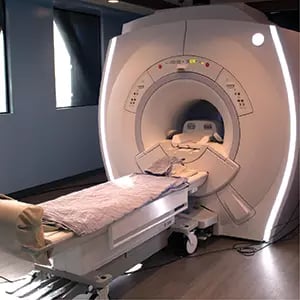
The scanner in our Provo clinic. Each treatment week starts with an fNCI functional MRI.
TBI treatment at Cognitive FX in Provo, Utah: the facts
Medically reviewed by Lynn M. Gaufin, MD, Director of Neurosurgery. Last reviewed October 22, 2026.
- Who it is for
- Adults, and teens with a parent present, with a traumatic brain injury, mild to severe, who are medically stable and whose progress with local care has leveled off.
- What we aim for
- Better function in one or two areas you choose for each week. When part of the brain is damaged, treatment trains the networks that still work well to take over those tasks.
- Where
- 280 W River Park Drive, Suite 110, Provo, Utah 84604. Provo Airport is 15 minutes away; Salt Lake City International is 45.
- What treatment is
- A functional MRI scan (fNCI), then a week of cognitive, speech, occupational, vision and physical therapy in one building, planned around your goals and your scan.
- How long
- One week at a time, about 9 to 5 with rest built in. Most people with structural brain injury return for a second week after about six weeks of rest and a home program.
- Cost
- $13,000 for the first week; $11,000 for a return week, including a new scan. A stand-alone fNCI scan is $1,500, credited toward treatment if you continue. CareCredit, HSA and FSA accepted.
- Insurance
- Out-of-network. We provide a superbill after treatment; reimbursement varies by plan and is not guaranteed.
- What you need
- Medical stability, controlled seizures if you have them, the ability to take part in several hours of outpatient therapy a day, and a companion for the week if you cannot manage travel and daily life alone. Wheelchair users are welcome after a full evaluation.
- First step
- A free video consult. You answer a few questions about your injury first, so the clinician on your call already knows your history.
For people ready to consider treatment in the next few months. We will tell you honestly what treatment can do for your injury.
What can treatment do for a brain injury months or years later?
It depends on the injury, so we start with an honest answer about yours.
After a concussion or mild TBI, brain structure usually looks normal on a standard MRI, and the problem is how brain regions work together. Our post-concussion syndrome treatment page covers that group in detail.
After a moderate or severe TBI, part of the brain may be physically damaged. Brain cells that died do not grow back, and no clinic can restore them. What can change is how well the rest of your brain handles the tasks you care about. Your brain keeps networks that still work, and with focused, repeated practice they can learn to take on jobs the damaged areas used to do. That is what a week at Cognitive FX trains.
So we do not promise a return to your brain before the injury. We set specific goals for each week, measure where you start, and work on those goals all week.
The usual plan for structural brain injury. Some people keep progressing at home and do not need a second week.
Who should I see for a brain injury that is still affecting my life?
Most people with a moderate or severe TBI have already been through hospital care and inpatient rehabilitation. After that, care is usually spread across several offices.
The usual path after rehab
- Neurologist or physiatrist
- Physical therapist
- Occupational therapist
- Speech-language pathologist
- Neuropsychologist
- Neuro-optometrist
Different offices, usually once or twice a week, and many insurance plans cap the number of therapy visits.
A goal-focused week at Cognitive FX
fNCI scan + your goalsOne plan for the whole team
- Cognitive and speech therapy
- Occupational and vision therapy
- Neuromuscular therapy
- Neurointegration therapy
- Psychological support
One building. Full days for a week. The same goals all week.
If you have new or worsening symptoms, such as a headache that keeps getting worse, repeated vomiting, a seizure, slurred speech, new weakness or numbness, or growing confusion, go to an emergency room or call 911.
How is a goal-focused week different from weekly rehab?
- One or two goals per week
- You and your team pick what matters most right now. Every session that week works toward those goals.
- A plan built from your scan
- An fNCI functional MRI shows which brain networks are working well while you do tasks. With structural damage, those working networks are what we train to take over.
- Full days instead of weekly visits
- At home, one or two sessions a week is often the most you can get. Here you get full days of therapy with structured rest, and your team reviews your progress at the end of each day.
- Rest, then build again
- Most people with structural injury come back for a second week about six weeks later. The time between weeks gives your brain time to consolidate what it learned while you keep practicing at home.
| Inpatient rehabilitation | Weekly outpatient therapy | Goal-focused weeks at Cognitive FX | |
|---|---|---|---|
| Often best for | The first weeks or months after a moderate or severe TBI, when you need medical care and supervision | Ongoing practice of one or two skills close to home | People who are medically stable and have plateaued, or want concentrated work on specific goals |
| Schedule | Several hours a day while admitted | 1 to 2 sessions a week | Full days for one week, then a home program; a return week about six weeks later is common |
| Coordination | One hospital team | Each provider usually works separately | One team, one scan, the same goals all week |
| Insurance | Usually billed to insurance | Usually billed to insurance, often with visit limits | Out-of-network; superbill provided |
| Cost to you | Copays and deductibles | Copays per visit | $13,000 for the first week; $11,000 for a return week |
General comparison; programs vary. Ask any provider about schedule, team and costs before you commit.
Who is a good candidate for TBI treatment at Cognitive FX?
We go through your history on a free consult before anyone books travel. We would rather tell you no from your living room than after you have flown to Provo.
- A traumatic brain injury, mild to severe, with symptoms still limiting your work, school or daily life
- Medically stable, with progress in local therapy that has leveled off
- A specific thing you want to be able to do again
- Able to take part in several hours of outpatient therapy a day, with rest breaks
- Still in acute care or inpatient rehabilitation, or needing medical care around the clock
- Seizures that are not controlled
- Unable to manage travel and daily life during the week, with no companion who can come
- A recent concussion with limited symptoms; many of these resolve with local care and time
Most people come once local therapy has stopped producing gains. Some choose to come sooner and keep their local therapy going alongside; we will talk through what to expect for your injury. Wheelchair users are welcome. We start with a full evaluation and set clear expectations for your recovery before you commit to a treatment week.
What do people work on during a TBI treatment week?
The goals people choose most often:
- Speaking and finding words
- Clearer speech, word retrieval, keeping up in conversation.
- Vision
- Eye tracking and focus, reading, screens, visual processing.
- Motor control
- Balance, coordination, steadier and more accurate movement.
- Headaches
- Fewer and less severe headaches, and knowing what sets them off.
- Brain fog
- Attention, memory, processing speed and mental stamina.
- Work or school
- The focus, memory and stamina a job or classes demand.
On Day 0 we measure where you start on each goal with tests matched to it, such as speech, vision, balance and gait testing. We repeat them on Day 5 so you can see what changed.
How does TBI treatment at Cognitive FX work?
- From homeA few questionsAbout 10 minutes on your injury and symptoms, then you pick a consult time.
- Video callFree consultA member of our treatment team tells you honestly what treatment can do. If it fits, we ask for your imaging reports and records.
- About 6 weeksWait for your weekTypical time from an accepted consult to your treatment week.
- Day 0Scan and goals56 brain regions measured; you settle your one or two goals and take the starting tests.
- Days 1 to 4Full days of therapyAbout 9 to 5, all aimed at your goals, with rest built in.
- Day 5Re-scan and home planA second scan and repeat goal tests show what changed.
- About 6 weeksRest and home programVideo follow-ups with our team; we can also talk with your local care team.
What does the fNCI scan show after a brain injury?
A standard MRI or CT shows brain structure: where tissue is damaged. fNCI is a functional MRI protocol that measures activity across 56 brain regions while you do cognitive tasks in the scanner, and compares your pattern to a normative database. After a structural injury, the useful question is which networks still work well. The scan shows those networks, and your therapy is aimed at training them to handle the tasks the injured areas used to manage.
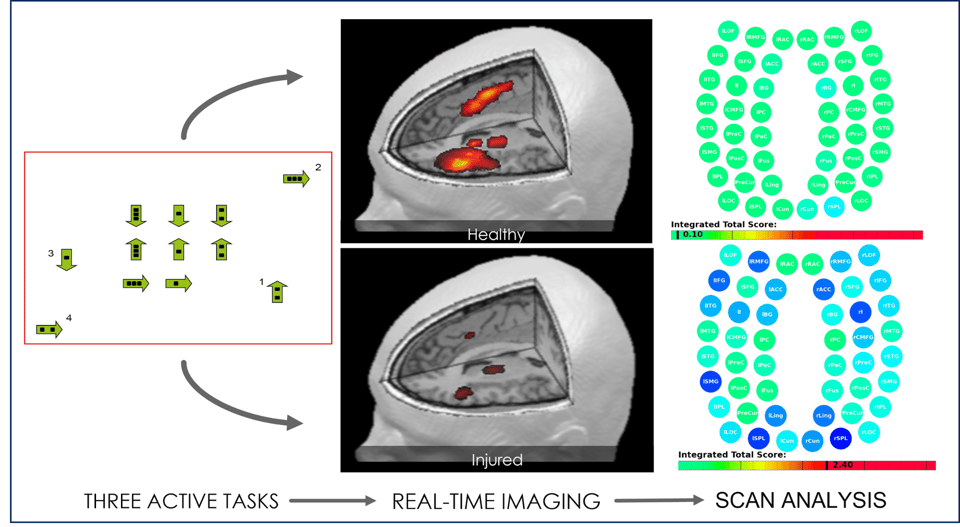
How the scan works: thinking tasks, real-time imaging, then analysis.
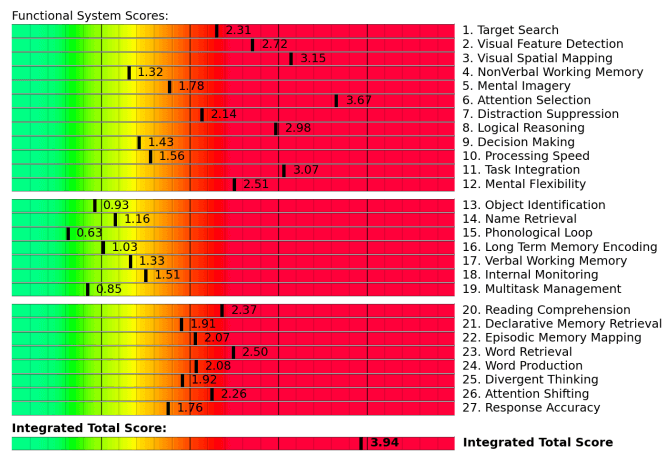
A page from a real fNCI report: color-coded scores for each brain system.
fNCI is a measurement tool, used alongside your history, exams and other imaging. It is not a stand-alone diagnosis. The method is published in peer-reviewed literature (Wing et al., The Open Neuroimaging Journal, 2017).
Which therapies are part of the treatment week?
Each day rotates through these disciplines, chosen and weighted by your goals.
- Cognitive and speech therapy
- Sessions with speech-language pathologists on speech, word finding, memory, attention and executive function.
- Occupational and vision therapy
- Tasks that combine vision with balance, attention, memory and motor skills, to improve eye movements and everyday tasks.
- Neuromuscular therapy
- Balance, coordination and vestibular work, therapeutic massage for the head and neck, and exercise that supports blood flow to the brain.
- Neurointegration therapy
- Evaluates how sight, balance and movement work together, then retrains the systems working inefficiently.
- Sensory therapy
- Exercises that stimulate vision and hearing together, so therapists can target weaker areas.
- Psychological support
- Depending on your needs, sessions with a psychologist on the emotional toll of a brain injury, plus recommendations for support at home.
Scan and goals
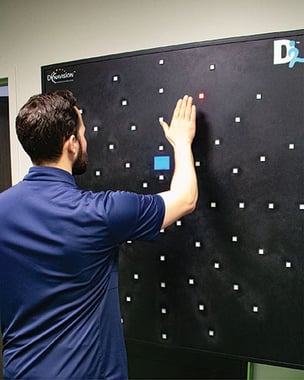
Full days on your goals
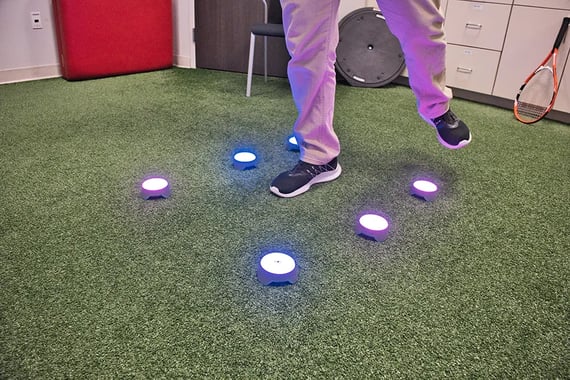
Re-scan and home plan
Does TBI treatment at Cognitive FX work?
What people with a TBI wrote on Google (excerpts trimmed for length):
“I suffered a TBI the previous January by falling and hitting my head when it was icy on concrete steps. I would not be back to work and making the progress that I have without this program!”
“It is a slow recovery but my reflexes, memory, cognition, focus, and comprehension are all improving daily. Highly recommend looking into this treatment for anyone with TBI...”
Individual results vary. Read all of our Google reviews, including the critical ones.
Our published outcome research, including the independent study by Amsterdam UMC and UMC Groningen, was done with patients who had persistent post-concussion symptoms. It does not tell you what to expect after a moderate or severe TBI, so we do not quote it here. Ask us on your consult what progress has looked like for people with injuries like yours.
What happens between and after treatment weeks?
The weeks at home matter as much as the week in Provo. You leave with a home program built around your goals and keep practicing it, with scheduled video follow-ups with our team. If it helps, we can also talk with your local care team.
About six weeks later, we look at your progress together. Many people with structural injury come back for a second week, either to push further on the same goals or to start on the next ones. Some keep progressing at home and do not need another week. We will tell you which we recommend and why.
How much does TBI treatment cost?
First treatment week
fNCI scan before and after treatment, a full multidisciplinary week focused on your goals, home program and follow-ups.Return week
A new fNCI scan, a full therapy week on your next goals, and an updated home program. Recommended when your progress supports it, usually about six weeks after the first.fNCI scan only
A first step if you are unsure. Credited toward treatment if you continue.Is TBI treatment covered by insurance?
Cognitive FX is out-of-network. After treatment we give you a superbill, and some patients recover part of the cost through out-of-network benefits. Reimbursement varies by plan and is not guaranteed. Ask your plan whether it covers out-of-network rehabilitation and how it handles superbills.
Injured in a car accident? Ask your auto insurer whether personal injury protection (PIP) or medical payments coverage applies, and ask your attorney whether treatment can be paid from a settlement. We provide a superbill and your treatment records for those claims.
How do patients travel to Cognitive FX in Provo, Utah?
Provo Airport is 15 minutes from the clinic; Salt Lake City International is 45 minutes. Most patients fly in the day before, start with the scan on Day 0, and fly home the day after their last session. If you need a companion for the week, plan for two travelers. Your scheduling call covers flights, hotels and what to pack. Travel and lodging guide.
Who treats patients at Cognitive FX?
A multidisciplinary clinical team, led by the clinic’s co‑founders. You meet them, not a franchise.

Dr. Alina K. Fong, PhDCo‑founder. Clinical neuropsychologist and clinical director.

Dr. Mark D. Allen, PhDCo‑founder. Neuroscientist, Johns Hopkins PhD, 10,000+ clinical fMRI assessments.

Dr. Lynn M. Gaufin, MDDirector of Neurosurgery.

Dr. Diane Spangler, PhDClinical psychologist.

Annie Morgan, RNDirector of Patient Care.
TBI treatment at Cognitive FX: frequently asked questions
Can a traumatic brain injury be treated years later?
Yes, although what treatment can do depends on the injury. Cognitive FX in Provo, Utah treats people with mild to severe TBI who are months or years past their injury and still limited in daily life. With structural damage, treatment trains the brain networks that still work to take on the tasks you choose. Your free consult tells you what is realistic for your injury.
Can damaged parts of the brain heal after a TBI?
Brain cells that die in a traumatic brain injury do not grow back. The rest of the brain can learn to take on some of the work those areas did, through focused and repeated practice. Cognitive FX in Provo, Utah builds each treatment week around that: one or two goals, worked on all week, with therapy aimed at the networks a functional MRI shows are working well.
What is the best treatment for a TBI after inpatient rehab ends?
No single treatment fits everyone. Most people continue with outpatient physical, occupational and speech therapy, often once or twice a week. If progress has leveled off, an intensive outpatient program concentrates those therapies into full days. Cognitive FX in Provo, Utah runs one-week programs for people with mild to severe TBI, focused on one or two goals per week.
How many treatment weeks will I need?
It depends on your injury and your goals. People with concussion or mild TBI often need one week. Most people with structural brain injury return for a second week after about six weeks of rest and a home program. Cognitive FX recommends a return week only when your progress supports it.
How much does TBI treatment at Cognitive FX cost, and does insurance pay?
Cognitive FX in Provo, Utah charges $13,000 for the first treatment week and $11,000 for a return week, which includes a new scan. A stand-alone fNCI scan is $1,500, credited toward treatment if you continue. The clinic is out-of-network; patients receive a superbill, and reimbursement varies by plan. CareCredit, HSA and FSA are accepted.
Do you treat severe TBI?
Yes, if you are medically stable, any seizures are controlled, and you can take part in several hours of outpatient therapy a day. Most patients come once progress with local therapy has leveled off. If you cannot manage travel and daily life on your own, a companion needs to come for the week. Your consult covers all of this before anyone books travel.
Do you treat people who use a wheelchair?
Yes. We start with a full evaluation and set clear expectations for recovery before you commit to a treatment week. Tell us about your mobility before your consult so we can plan the week around it.
What can I work on during a treatment week?
You choose one or two goals with your team. Common ones are speaking and word finding, vision and reading, balance and motor control, headaches, brain fog, and the focus and stamina for work or school. Every session that week works toward those goals, and we test each goal on Day 0 and again on Day 5.
Can a functional MRI help when my brain injury shows on a regular MRI?
A regular MRI or CT shows where tissue is damaged. A functional MRI shows how brain regions perform while you work. At Cognitive FX in Provo, Utah, the fNCI scan maps 56 regions during cognitive tasks so therapy can target the networks that are working well. It is one measurement among several, not a stand-alone diagnosis.
Do I need a companion during treatment?
Only if you cannot manage travel, appointments and daily life on your own for the week. Many people with severe TBI bring a family member or caregiver. Tell us before your consult and we will help you plan.
Do you treat teenagers with a brain injury?
Yes, with a parent or guardian present throughout the week. If your teen is months past a brain injury and still struggling with school, sports or daily life, the free consult is the place to start.
My brain injury came from a car accident. Can auto insurance or a settlement pay for treatment?
Ask your auto insurer whether personal injury protection (PIP) or medical payments coverage applies, and ask your attorney whether treatment can be paid from a settlement. Cognitive FX provides a superbill and your treatment records for those claims.
Where can I get TBI treatment in Utah?
Cognitive FX treats traumatic brain injury at 280 W River Park Drive, Suite 110, Provo, Utah 84604, 15 minutes from Provo Airport and 45 minutes from Salt Lake City International. For a recent injury or new symptoms, start with your doctor or an emergency room.
Book your free consult
For people with a brain injury considering a one-week, $13,000 program in Provo. We will tell you honestly what treatment can do for your injury.
About 10 minutes of questions. Your injury, symptoms, and what you have already tried.
Pick your consult time. The calendar opens at the end of the questions.
A straight answer on a video call. A call with a member of our treatment team: yes with a plan and dates, or no with better options for your situation.
Want to start with just the $1,500 scan? Ask on your call.
We ask about your injury first so the clinician on your call already knows your case and can give you a real answer.
Your answers go directly to our clinical team and are kept confidential. No spam, no sales list. Not ready to book yet? Send this page to yourself for the morning.
Prefer to talk first? Call (385) 375‑8590, 9–5 Mountain, and ask for the patient care team.