You had a TIA. The ER ran a brain scan. Someone in a white coat said it looked clean, handed you discharge papers, and sent you home. But here you are, foggy, tired, forgetting words, feeling a little like a stranger in your own head. You searched "does a TIA show up on an MRI scan" because a clean report doesn't match what your body is telling you.
You're not imagining it, and you're not alone. Research into the the after effects of a TIAshows that most patients have lingering symptoms for weeks or months but a subset can have symptoms for years. Below, we'll explain what an MRI can actually see after a TIA, why a normal scan is common, and what options exist when structural imaging can't explain how you feel.
When to call 911, do not wait it out.
Stroke symptoms require emergency treatment even if they go away. Per the American Heart Association, use BE-FAST:
- Balance loss
- Eyes (sudden vision change)
- Face drooping
- Arm weakness
- Speech difficulty
- Time to call 911
Also call 911 for a sudden severe headache, loss of consciousness, or sudden severe numbness or weakness on one side of the body. A TIA and a stroke look identical in the first minutes. Only imaging and time can tell them apart.
The Short Answer
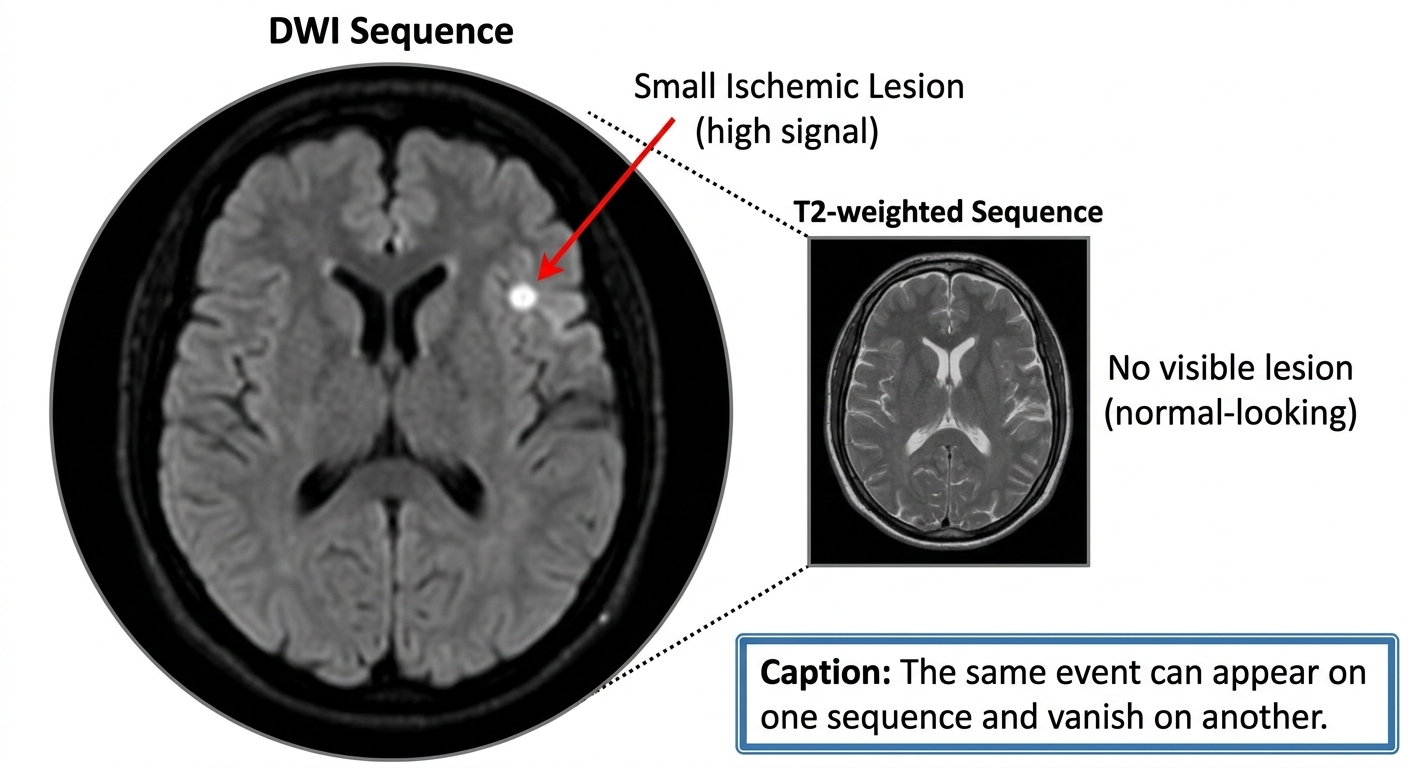
Sometimes. A standard MRI often looks normal after a TIA, but diffusion-weighted MRI (DWI) detects a small ischemic lesion in roughly 30 to 50% of cases when performed within 24 to 48 hours of symptoms. After that window, many lesions fade and are no longer visible on imaging.
A clean MRI after a TIA is common, not unusual. "Normal scan" is not the same as "normal brain." Below is what the scan is actually looking for, and what it can miss.
What an MRI Actually Looks For After a TIA
Brain MRI after a suspected TIA is usually the first detailed imaging a patient receives after and evaluation at a hospital. The scan is not one image. It's several sequences, each tuned to see different things.
Standard MRI sequences (T1, T2, FLAIR)
- T1-weighted: Shows anatomy, the shape and structure of the brain.
- T2-weighted: Highlights fluid and edema; helpful for older injuries.
- FLAIR: Suppresses normal spinal fluid signal to make white-matter changes and older infarcts easier to see.
These sequences are excellent for detecting completed strokes, tumors, bleeding, and long-standing small-vessel disease. They are not designed to catch the kind of brief, minutes-long oxygen shortage that defines a TIA.
Diffusion-weighted imaging (DWI) and why it matters
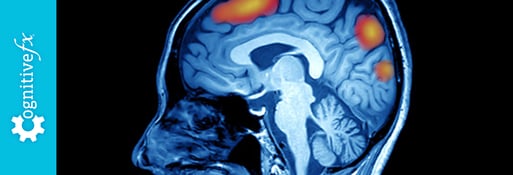
DWI is the sequence that changed TIA imaging. It detects restricted movement of water molecules in brain tissue, which happens within minutes when cells are briefly starved of oxygen. The result, when present, looks like a small, bright spot.
A landmark pooled analysis of 47 studies and 9,078 patients found that roughly one in three TIA patients have a visible DWI lesion (34.3%, with individual studies ranging from 9% to 67%). In other words, about two in three TIAs do not leave a visible mark on the most sensitive standard MRI sequence.
MRI vs. CT: the detection gap
In the ER, a non-contrast CT is almost always done first. That's the right call. CT is fast and excellent at ruling out bleeding. But for ischemic injury, CT is far less sensitive than MRI. Studies comparing the two in suspected TIA patients have found CT detects an acute lesion in the single digits while MRI with DWI catches it roughly one-third to two-fifths of the time. NICE guidelines and the AHA/ASA 2023 scientific statement both list MRI with DWI as the preferred test, with CT reserved for when MRI isn't available.
[INSERT IMAGE: Simple side-by-side comparison graphic: "CT ~8% detection" vs "MRI with DWI ~39% detection" for acute ischemic lesions in TIA. Minimal, clinical design.]
Why Timing Matters: The 24 to 48 Hour Window
DWI is sensitive, but it's sensitive for a reason, and for a limited time. The biochemical changes it picks up peak within hours and then slowly fade over days. Major guidelines, including the 2023 AHA/ASA scientific statement, recommend brain MRI within 24 hours of TIA symptoms for this reason.
What gets missed if you wait weeks to months
If your scan happened a week or more after the event, a small lesion that was visible on day one may be gone. A normal MRI at two weeks doesn't rule out a TIA. It just means the window has closed. This matters if you're trying to piece together, months later, whether "that episode last fall" was really a mini-stroke. Ask your doctor whether a follow-up MRI is warranted and what sequences to request.
What "TIA vs. Stroke on MRI" Really Means
This is one of the most confusing parts of the whole conversation.
When a clean MRI is still called a TIA
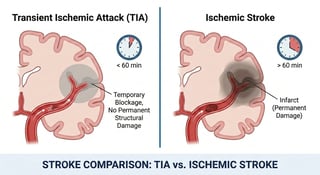
In 2009, the American Heart Association updated the definition of TIA to "transient neurological dysfunction caused by focal brain ischemia without acute infarction." Translation: if the symptoms went away and the MRI is clean, it's a TIA.
When a visible lesion reclassifies it as a minor stroke
Under that same 2009 definition, if imaging shows an acute infarct, even a tiny one, the event is technically a minor ischemic stroke, not a TIA, regardless of how quickly symptoms resolved. In practice, many clinicians still use "TIA" conversationally for small DWI-positive events. The label matters for two reasons:
- Stroke-risk prediction. One study found 7-day stroke recurrence was 7.1% after DWI-positive events versus 0.4% after DWI-negative events.
- Long-term planning. A visible lesion usually tips workup toward a more intensive hunt for the source (cardiac, large-vessel, or small-vessel).
Either way, the prevention playbook (blood pressure, cholesterol, rhythm monitoring, lifestyle) is similar.
When the MRI Is Clean But Symptoms Persist
This is the situation that brings most readers to this page. Your MRI came back normal after TIA. You were told everything looks fine. And you still feel off.
There are three honest explanations worth knowing about.
Silent strokes and small-vessel changes
Sometimes the "nonspecific findings on brain MRI" in a radiology report are small, older white-matter changes, the footprint of chronic small-vessel disease. Silent strokes (also called covert infarcts) are visible on imaging without a corresponding clinical memory of stroke symptoms. They're common: 8 to 28% of community-dwelling adults over 60 have at least one, and NEJM data links them to more than double the risk of future dementia. These findings deserve a real conversation with your neurologist, not a shrug.
Tissue-negative TIA and perfusion imaging
A "tissue-negative" TIA means the standard structural scan, including DWI, is clean. That does not mean nothing happened. Advanced perfusion techniques like arterial spin labeling (ASL) have been shown to detect abnormal blood flow in DWI-negative, vessel-imaging-negative TIA patients. And separately, some patients who look neurologically fine actually have TIA taht mimics other conditions (migraine aura, seizures, low blood sugar, peripheral vestibular problems) which matter to identify because the treatment differs.
Why structural MRI can miss functional damage: the neurovascular-coupling angle
Here's the piece most patient-facing articles leave out. Structural MRI is a photograph of brain architecture. It wasn't built to measure how well regions of your brain are communicating, the coordinated dance between neurons firing and blood flow rushing in to feed them, a mechanism called neurovascular coupling. When that coupling is disrupted, symptoms like brain fog, word-finding problems, and post-TIA fatigue can persist even while the structural scan stays boringly normal. A 2014 study found that about 85% of TIA and minor-stroke patients showed cognitive abnormalities within 24 hours, many of whom had unremarkable structural imaging.
If your MRI came back clean but you still don't feel like yourself
A normal structural MRI rules out several serious things, and that is reassuring. It does not rule out the functional changes that often follow a TIA. At Cognitive FX, we use functional MRI, a specialized MRI protocol that measures blood-flow and activation patterns across 56+ brain regions during cognitive tasks, then compares them to a normative dataset. fNCI is not a replacement for MRI and is not used to diagnose TIA. It maps where neurovascular coupling is off, so rehabilitation can target those regions directly. If you're weeks to months out and still symptomatic, this is the picture your hospital MRI wasn't built to provide.
Functional Imaging: What fMRI Can Show That MRI Can't
How functional imaging measures brain activity, not just structure
Functional imaging doesn't replace structural MRI. It answers a different question. Instead of asking "is this tissue damaged?", it asks "is this tissue working the way it should?" fNCI uses the same MRI scanner you've likely already been in, but runs a different protocol: you perform a series of standardized cognitive tasks while the scanner measures the BOLD (blood-oxygen-level-dependent) signal. That signal reflects neurovascular coupling, the linkage between neuron activity and local blood flow. Comparing your pattern to a normative dataset reveals regions where the response is too high, too low, or poorly timed.
When to consider advanced imaging after a normal MRI
Functional imaging is worth a conversation with your doctor when all three of the following are true:
- Your structural MRI and vessel imaging are clean (or only show small, chronic changes).
- You are at least several weeks out from the event.
- You still have cognitive, emotional, or physical symptoms affecting work, relationships, or daily life.
Lingering Symptoms After a TIA
The UK Stroke Association reports that roughly 70% of TIA patients experience long-term after-effects, and about 60% report emotional changes, numbers that line up with what patients tell us most often. These are not weakness or imagination. They are common consequences worth naming.
Brain fog and cognitive changes
Trouble focusing. Losing a word mid-sentence. Forgetting why you walked into a room. These are the most common cognitve problems after a TIAand they tend to be underrecognized because routine clinical visits rarely screen for them.
Post-TIA fatigue
The kind of fatigue that sleep doesn't fix. You finish a normal workday and feel like you ran a marathon. Post TIA fatigueis one of the most reported symptoms and one of the slowest to resolve on its own.
When to seek further evaluation
Consider further evaluation if, weeks after your event, you're still experiencing any of the following:
- Persistent brain fog, memory loss after mini stroke, or word-finding problems after TIA
- Unusual fatigue or sleep disruption
- Anxiety after mini stroke, mood changes, or irritability
- Blurry vision after TIA, balance problems, or headaches
- Difficulty returning to work, driving, or caregiving
Frequently Asked Questions
Can a TIA be seen on an MRI?
Sometimes. DWI detects a small lesion in roughly 30 to 50% of TIA cases when performed within 24 to 48 hours. In the other cases, the scan can look completely normal even though a real event occurred.
How soon after a TIA should you have an MRI?
Major guidelines recommend brain imaging within 24 hours. DWI sensitivity drops noticeably after that window, so earlier is better.
What does a TIA look like on an MRI?
When visible, it appears as a small bright spot on the DWI sequence, a dot of restricted water movement in tissue briefly starved of blood.
Can you have a TIA and have a normal MRI?
Yes. About two out of three TIAs leave no visible mark on standard MRI. A clean scan does not mean nothing happened. Doctor said it was a TIA but MRI was normal? That's the expected pattern, not a contradiction.
How long does a TIA show up on an MRI?
DWI signal from a small ischemic event typically remains visible for about a week to two weeks. After that, many small lesions are no longer detectable.
Does a TIA cause permanent brain damage?
By strict definition, a TIA does not cause permanent infarction. But research shows many patients experience cognitive and emotional changes for months, and that silent infarcts raise long-term dementia risk. Talk to your doctor if symptoms persist.
What is the difference between a TIA and a stroke on MRI?
A visible acute infarct on MRI technically reclassifies the event as a minor ischemic stroke under the 2009 AHA/ASA definition. A normal MRI with transient symptoms is typically called a TIA.
What tests are done to confirm a TIA?
Usually brain MRI with DWI, vessel imaging (MRA or CTA), carotid ultrasound, ECG with extended heart-rhythm monitoring, and blood tests for cholesterol, glucose, and clotting.
Can an MRI miss a stroke?
Yes. Very small, very early, or delayed-scan events can be missed, especially without DWI.
What is a silent stroke on MRI?
A silent or covert infarct is visible brain injury on imaging without a corresponding clinical memory of stroke symptoms. They are common and clinically meaningful.
How accurate is MRI for diagnosing TIA?
MRI is the preferred imaging test but is better at ruling in ischemic injury than ruling it out. A normal MRI alone does not exclude a TIA diagnosis.
What is DWI on an MRI?
Diffusion-weighted imaging is an MRI sequence that detects restricted water movement, making it the most sensitive standard method for spotting recent ischemic injury.
Getting the Right Scan and the Right Follow-Up
If a clean MRI can't explain what you're feeling, and the symptoms aren't imagined, then you'd want an imaging method that measures function, not just structure. That's what fNCI is built to do. It maps where neurovascular coupling is off, so rehabilitation can target those regions with neurological, cognitive, vestibular, psychological, and physical therapies coordinated in a single week-long EPIC program.
You don't need a diagnosis rewritten. You need the next useful picture.
After Effects of a TIA Article
This article is for educational purposes only and is not a substitute for medical advice, diagnosis, or treatment. Always call 911 for stroke symptoms and talk to your neurologist about your specific imaging and recovery plan.