A transient ischemic attack (TIA) is a temporary blockage of blood flow to the brain that produces the same symptoms as a stroke but resolves without visible infarction on MRI. About 1 in 10 people who have a TIA suffer a full stroke within 90 days, and roughly half of those strokes happen within the first 48 hours (Johnston, JAMA 2000). That makes a TIA one of the most urgent warning signs in medicine, not a minor event to sleep off.
This article explains what a TIA actually is under the current tissue-based definition, how it differs from a full stroke, how clinicians tell them apart, the real recurrence numbers, and why the nickname "mini stroke" undersells the risk. For lingering post-event symptoms.
Jump to your concern
TIA vs. stroke at a glance
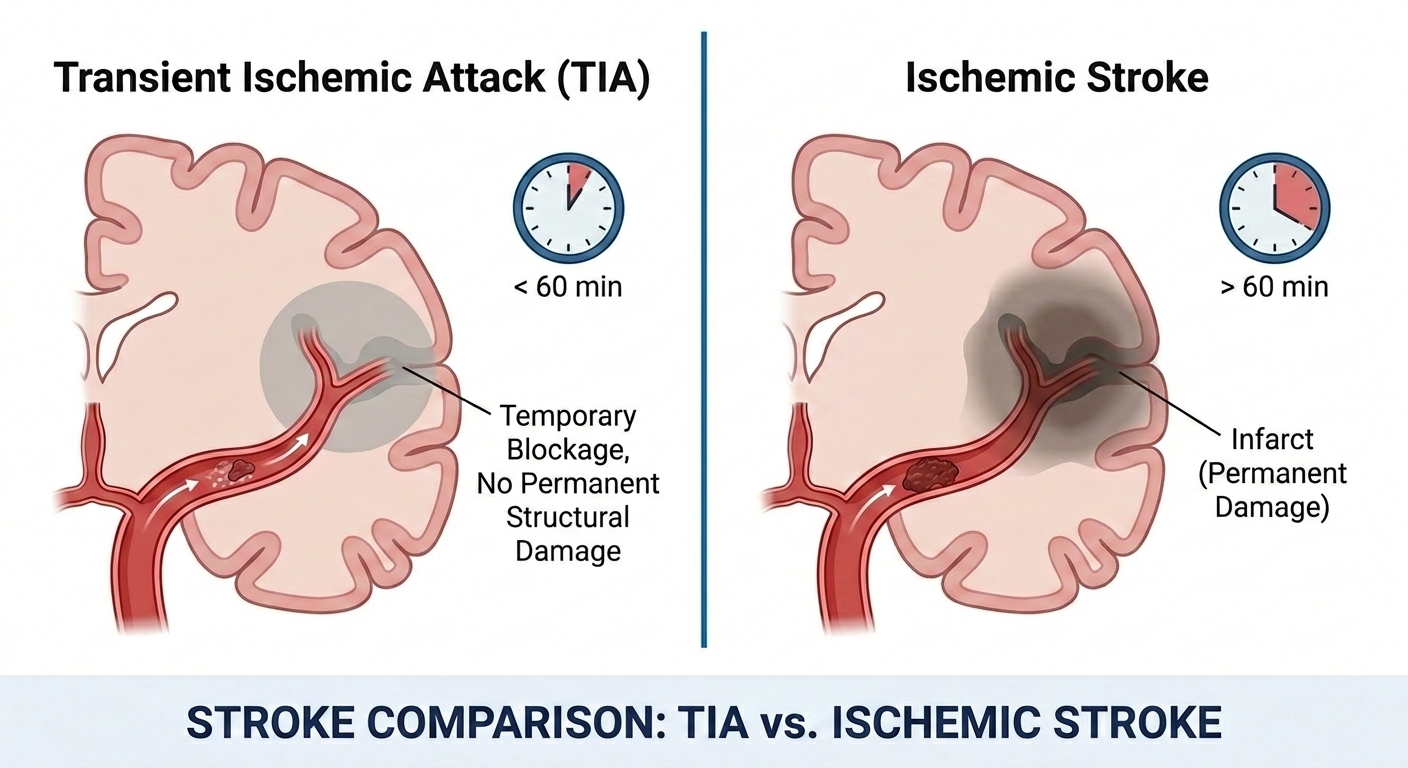
The one-sentence answer: A TIA and a stroke produce identical symptoms (facial droop, weakness, slurred speech, vision loss), but a TIA resolves, usually within an hour, without leaving a permanent lesion on MRI, while a stroke causes permanent brain-cell death. Both are medical emergencies.
Side-by-side comparison
| Feature |
TIA (Transient Ischemic Attack) |
Ischemic Stroke |
| Cause |
Temporary blockage of blood flow to brain, spinal cord, or retina |
Sustained blockage that kills brain tissue |
| Symptom duration |
Usually under 1 hour, almost always under 24 hours |
Ongoing until treated, often permanent |
| MRI (DWI) evidence |
No acute infarct visible |
Infarct visible on diffusion-weighted MRI |
| Lasting damage |
None on imaging by definition; cognitive and fatigue symptoms increasingly recognized |
Permanent tissue loss; deficits may improve with rehab |
| 90-day stroke recurrence |
Roughly 3 to 5% with urgent modern care; historically 10 to 15% |
Varies by stroke type and cause |
| Treatment urgency |
Emergency workup within 24 hours |
IV thrombolytic within 4.5 hours; thrombectomy within 24 hours for select patients |
| Hemorrhagic form? |
No. TIAs are always ischemic by definition |
Yes, about 13% of strokes are hemorrhagic |
What is a TIA, and why "mini stroke" misses the point
The 2009 AHA/ASA redefinition: tissue-based, not time-based
For decades, doctors defined a TIA by the clock. If symptoms cleared within 24 hours, they called it a TIA. If they lasted longer, they called it a stroke. That definition was wrong. Imaging studies kept showing permanent tissue damage in patients whose symptoms had resolved in minutes.
In 2009, the American Heart Association and American Stroke Association rewrote the definition. A TIA is a transient episode of neurological dysfunction caused by focal brain, spinal cord, or retinal ischemia, without acute infarction (Easton, Stroke 2009). The key phrase is "without acute infarction." It is a tissue-based call, made by imaging, not by stopwatch.
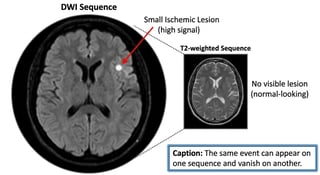
Why does this matter for you? About 30 to 35% of events that look like classic TIAs actually show a small infarct on diffusion-weighted MRI (Brazzelli 2014), and those are technically minor ischemic strokes, not TIAs. The symptoms may have been brief. The tissue damage is still real. Many clinicians, out of habit, still chart "TIA" on the discharge paperwork. If you want to know what actually happened, ask for a copy of your MRI report and look for the DWI result.
Why "mini stroke" is the wrong nickname
The word "mini" sounds like a small stroke. It is not. A TIA is either a near-miss of a stroke or, under current criteria, a small stroke that got relabeled. The recurrence numbers back this up. The highest risk of a full, disabling stroke is in the first 48 hours and first week after a TIA. That makes the event a warning siren, not a minor incident.
TIAs are also, by definition, always ischemic, meaning they come from a blockage. There is no such thing as a "mini hemorrhage." A bleed in the brain is a hemorrhagic stroke, not a TIA, and it is managed the opposite way. Ischemic stroke accounts for about 87% of strokes in the United States. The remaining 13% are hemorrhagic, caused by a ruptured vessel rather than a clot. This is why imaging, not symptoms, drives acute decisions in the ER.
Why do a TIA and a stroke look identical?
BE-FAST in practice
In the acute moment, you cannot tell a TIA from a stroke by symptoms alone. The job is to recognize the emergency and call 911. BE-FAST is the checklist (see the callout above for the full list).
Less obvious symptoms most articles skip
Public-awareness campaigns focus on face droop, arm weakness, and slurred speech. Those are real and common, but they are not the whole story. A TIA or stroke can also present as:
- Amaurosis fugax. Sudden painless vision loss in one eye, like a curtain coming down and lifting. This is a TIA of the retina. It is an emergency workup, not a "wait and see."
- Sudden severe vertigo. Room-spinning dizziness that is not positional, often with imbalance or trouble walking. Posterior-circulation strokes present this way and get missed often.
- Confusion or trouble understanding speech. Not just slurred words but a sudden inability to process what someone else is saying, or to find your own words (aphasia).
- Sudden numbness or tingling on one side of the face, arm, or leg.
- Sudden severe headache, especially a "worst headache of my life." More common with hemorrhagic stroke.
- Drop attacks or sudden falls without warning, without loss of consciousness, with recovery afterward.
In Aroor's 2017 review of 736 consecutive ischemic stroke patients, 14.1% had no FAST symptoms at presentation. Of those FAST-negative cases, 70% had either a gait abnormality or a visual impairment (Aroor, Stroke 2017). The practical lesson: a sudden change in balance or vision is a stroke symptom until proven otherwise.
Why you cannot tell TIA from stroke without imaging
Even experienced neurologists cannot reliably distinguish a TIA from a minor stroke at the bedside. The only way to make the call is with imaging, usually diffusion-weighted MRI. This is why acute stroke care is built around treat first, confirm later. If you arrive within 4.5 hours of onset and imaging rules out a bleed, clot-buster decisions get made on the assumption that something bad is in progress.
How do doctors actually tell them apart?
CT vs. MRI, and why DWI-MRI is the gold standard
The first scan in the ER is almost always a non-contrast CT of the head. CT is fast and very good at one job: ruling out bleeding. It is not good at detecting small, acute ischemic infarcts, which may not show up in the first several hours.
MRI with diffusion-weighted imaging (DWI) is the gold standard for confirming or excluding an acute ischemic lesion. DWI can detect lesions within minutes of onset. The 2023 AHA scientific statement on the ED workup of suspected TIA recommends MRI with DWI as the preferred imaging.
Other tests in a standard TIA workup: carotid ultrasound or CT angiography, ECG and often 24 to 72 hours of cardiac monitoring (to screen for atrial fibrillation), echocardiogram, fasting lipids, HbA1c, and blood pressure review.
The "minor stroke" gray zone
Here is the part most patients are never told. Roughly one-third of events that look like a classic TIA by symptoms (brief, resolved) actually show a small bright spot on DWI. Under the 2009 definition, those events are minor ischemic strokes, not TIAs (Brazzelli, Health Technol Assess 2014). Many clinicians still write "TIA" on the chart when symptoms resolved, even if the MRI was positive. If you care about knowing what actually happened, ask two questions: "Did I have an MRI with DWI?" and "Was the DWI positive or negative?"
ABCD2 score
The ABCD2 score is a quick clinical rubric that stratifies short-term stroke risk after a TIA. It was validated in Johnston's 2007 Lancet paper against actual 2-day, 7-day, and 90-day outcomes.
| Factor |
Criterion |
Points |
| Age |
60 years or older |
1 |
| Blood pressure |
Systolic 140 or diastolic 90 mmHg or higher |
1 |
| Clinical features |
Unilateral weakness |
2 |
| |
Speech disturbance without weakness |
1 |
| Duration |
60 minutes or longer |
2 |
| |
10 to 59 minutes |
1 |
| Diabetes |
Known diabetes |
1 |
Total score ranges from 0 to 7. Two-day stroke risk per Johnston 2007: score 0 to 3 about 1.0%, score 4 to 5 about 4.1%, score 6 to 7 about 8.1%. ABCD2 is a screening tool, not a license to send anyone home. Current AHA guidance recommends urgent same-day to within-24-hour specialist assessment for essentially all suspected TIA patients, regardless of score (AHA 2023).
What is the real stroke risk after a TIA?
This is the question every patient wants answered. After a TIA, what are the odds of a full stroke, and when?
48 hours, 7 days, 90 days, 1 year, 5 years
The historical benchmark comes from Johnston's 2000 JAMA study of 1,707 patients with ED-diagnosed TIA. 90-day stroke risk was 10.5%, with 91 of the 180 strokes (about half) occurring in the first 2 days. Those numbers shaped a generation of practice but came from an era before rapid-access TIA clinics, widespread dual-antiplatelet therapy, and routine statins.
More recent data is less frightening but still sobering. The EXPRESS study in Oxford showed that urgent assessment and treatment cut 90-day stroke recurrence from 10.3% to 2.1% (Rothwell, Lancet 2007). The TIAregistry.org study, which followed more than 4,700 patients across 21 countries, reported a 1-year stroke rate of 5.1% (Amarenco, NEJM 2016) and a 5-year stroke incidence of 9.5% (Amarenco, NEJM 2018).
The honest answer about 90-day recurrence is a range. Historically, roughly 10 to 15%. With modern urgent care, closer to 3 to 5%. The single biggest lever is how fast you get evaluated and started on preventive therapy.
Acute treatment windows
If symptoms do not resolve, or come back and stay, the clock matters.
Intravenous thrombolytic (alteplase or tenecteplase) is given within 4.5 hours of symptom onset for eligible ischemic stroke patients. The drug breaks up the clot chemically. Eligibility is tight (blood pressure control, no recent bleed or surgery), and benefit drops steeply as the clock ticks.
Mechanical thrombectomy is a catheter-based procedure to physically pull the clot out of a large vessel. The window has been extended, for carefully selected patients with favorable imaging, to up to 24 hours from last-known-well. Thrombectomy is reserved for large-vessel occlusions and has transformed outcomes for that subset. Time is brain. If you think you are watching a stroke unfold, call 911 immediately.
Why does "mini" not mean "minor"?
Common lingering symptoms even when MRI is clean
The medical shorthand treats a TIA as a resolved event. The lived experience is often different. Patients routinely report one or more of the following in the weeks and months after a TIA, even with a normal MRI:
- Persistent fatigue that feels different from ordinary tiredness, often worse late in the day.
- Brain fog. Slower mental processing, losing your train of thought, forgetting why you walked into a room.
- Short-term memory problems. Reading a page and not retaining it.
- Headaches, sometimes new in character.
- Irritability, anxiety, or low mood, often out of proportion to the trigger. Families often notice personality changes the patient does not see.
- Sensory sensitivity to light, noise, and crowded environments.
- Trouble with complex tasks that used to feel automatic, like planning a week or handling paperwork.
Post-TIA cognitive impairment
Research has increasingly documented that TIAs leave measurable cognitive fingerprints. A 2016 study by van Rooij and colleagues compared TIA patients to matched controls and found real cognitive deficits that persisted after symptom resolution. Pendlebury and Rothwell's 2009 Lancet Neurology review showed that dementia prevalence after recurrent stroke reaches about 30%, compared with roughly 10% after a first-ever stroke. The cognitive impact is real, understudied, and easy to miss when symptoms have technically resolved.
The "clean MRI" problem
One of the most frustrating patient experiences: you feel worse than you did before the TIA, your imaging looks normal, and the response you get is essentially "everything checks out." The mismatch is not imaginary. Standard clinical MRI is a snapshot of structure. It does not measure how efficiently blood flows to working brain regions during cognitive effort, how well neurons and blood vessels coordinate, or how networks are communicating. Functional neuroimaging can pick up patterns that structural MRI cannot.
Secondary prevention and recovery
Antiplatelet therapy and the DAPT window
After a TIA or minor ischemic stroke of atherosclerotic origin, guidelines recommend starting antiplatelet therapy immediately. For high-risk TIA (ABCD2 of 4 or more) or minor ischemic stroke, short-term dual antiplatelet therapy (aspirin plus clopidogrel for about 21 days) reduced the 90-day stroke rate from 11.7% to 8.2% in the CHANCE trial (Wang, NEJM 2013). The POINT trial showed a similar benefit on 90-day major ischemic events (Johnston, NEJM 2018). After the DAPT window, most patients step down to a single antiplatelet agent long-term.
Anticoagulation, blood pressure, statins, and lifestyle
If the workup finds atrial fibrillation, antiplatelet therapy is not enough. Anticoagulation (a direct oral anticoagulant or warfarin) is the right tool for a cardioembolic source. Most of the long-term risk reduction after a TIA comes from unglamorous basics: blood pressure below about 130/80 mmHg, moderate-to-high-intensity statin therapy, tight diabetes control where relevant, smoking cessation, physical activity, a Mediterranean-style eating pattern, sleep, and alcohol moderation (2021 AHA/ASA Secondary Prevention Guideline). If significant narrowing of the carotid artery on the same side as your symptoms is found, carotid endarterectomy or stenting can sharply reduce future risk.
Rehabilitation for "minor" events
Formal stroke rehabilitation (speech therapy, occupational therapy, cognitive rehab, physical therapy) is routinely offered after a visible, disabling stroke. It is much less consistently offered after a TIA or minor stroke, because the system is built around visible deficits. Patients who feel off but look fine on paper fall through that gap. The CFX deeper piece on mini stroke recovery walks through what a practical rehab plan can look like. At Cognitive FX, post-TIA and minor-stroke patients start with an fNCI functional MRI scan, then move into an intensive week-long program of aerobic conditioning, cognitive therapy, neurointegration, and occupational and sensorimotor work, followed by a structured at-home plan.
Frequently asked questions
Getting the right evaluation after a TIA or mini stroke
If you or a family member had a TIA recently, the first priority is standard medical follow-up with a neurologist or stroke specialist and adherence to the secondary-prevention plan they set up. That is the single most important thing you can do in the next 90 days.
If you have done all of that and you still feel like a step behind, if the fatigue, brain fog, or irritability have not lifted, Cognitive FX may be worth exploring as a second layer of care.
This article is for educational purposes only and is not a substitute for medical advice, diagnosis, or treatment from a licensed clinician. If you or someone near you is having symptoms of a TIA or stroke, call 911 immediately.