If you’re a psychologist or mental health professional, chances are you’ve heard of transcranial magnetic stimulation (TMS)—maybe in the same breath as medications, ECT, or even ketamine. But the landscape has evolved quickly in the past few years. New-generation protocols like SAINT™ (Stanford Accelerated Intelligent Neuromodulation Therapy) have transformed what TMS can offer patients—and how easily it can fit alongside psychotherapy.
Many clinicians are surprised to learn how different these protocols are from the older, time-intensive versions of TMS they may have heard about. And while TMS is often grouped with other “biological” interventions, it offers a unique balance of effectiveness, safety, and integration potential that many psychologists don’t yet have on their radar.
If you work with patients who struggle with treatment-resistant depression—or if you’ve wondered what modern brain stimulation can add to your therapeutic toolbox—here are seven things you should know about new generation TMS:
- New TMS protocols offer significantly higher remission and response rates
- It Fits the “Combined Treatment” Model—But Better Than Medications
- Accelerated TMS Is Far Less Disruptive to Ongoing Psychotherapy
- TMS Boosts Neuroplasticity—Enhancing Psychotherapy Outcomes
- How TMS Differs From ECT: Clarifying Misconceptions
- TMS Provides More Sustained Recovery Compared to Ketamine
- Accelerated TMS Has Limited Insurance Coverage (So Far)
1. New TMS Protocols Offer Significantly Higher Remission and Response Rates
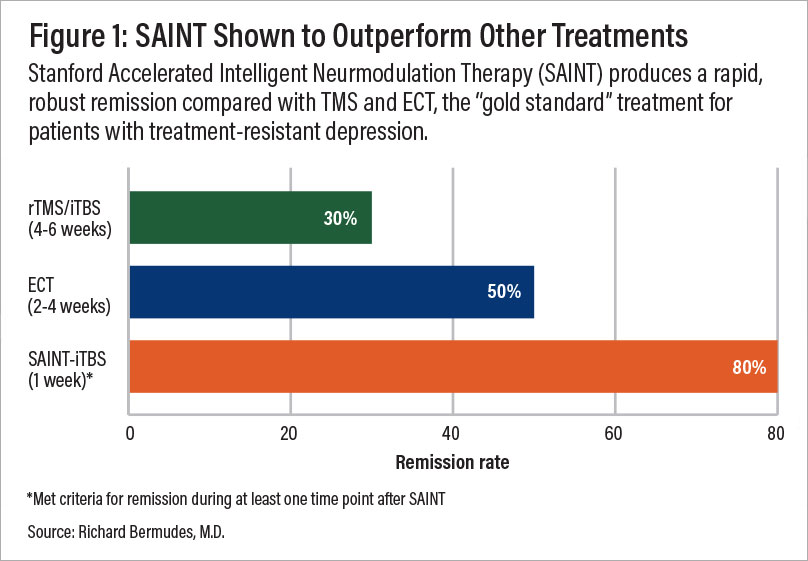
A comparison of remission rates for rTMS/iTBS, ECT, and SAINT-iTBS.
Conventional TMS—known as repetitive TMS—provides remission and response rates of around 30% and 50% respectively, offering a safe and effective alternative for patients where medications and psychotherapy haven’t adequately reduced depressive symptoms.
Stanford-developed SAINT™ TMS has improved on these outcomes substantially. In a double-blind, randomized controlled clinical trial, 85% of patients responded, and 78% achieved remission in one week of treatment. All participants had treatment-resistant depression, and remission rates remained around 60% one month after treatment.
A few key innovations made these results possible:
-
Functional MRI: Using fMRI enables the precise location of the treatment target area (the left dorsolateral prefrontal cortex or L-DLPFC) for every patient, accounting for individual variations in head shape, size, and brain structure.
-
Neuronavigation: Neuronavigation ensures that the magnetic coil is placed precisely over the treatment target site for every TMS session, leading to consistent treatment delivery throughout the entire course of treatment.
-
Intermittent Theta-Burst Stimulation (iTBS): Intermittent Theta-Burst Stimulation has reduced the time of each TMS session, enabling patients to undergo multiple sessions per day and shorten the overall treatment timeline.
The significance of precision targeting has now been validated by a groundbreaking study from researchers at Harvard Medical School, which found that patients were 2.3 times more likely to achieve a positive response to TMS when their treatment was precisely mapped to their unique brain circuitry with fMRI.
2. It Fits the “Combined Treatment” Model—But Better Than Medications
For decades, the gold standard in depression care has been combined treatment: pairing psychotherapy with a biological intervention, usually antidepressant medication. The rationale makes sense—address the biology to improve mood and motivation, then use therapy to create lasting change.
But for many patients, medication doesn’t deliver the level of improvement we’d hope for. It takes weeks or months to gauge effectiveness, side effects can be discouraging or intolerable, and outcomes are inconsistent. That can leave both patient and therapist feeling stuck.
New-generation TMS offers a way to preserve the method of combined treatment, while upgrading the biological component. Rather than introducing the adverse side effects, adherence issues, and delayed timelines of medication, TMS directly engages the neural networks involved in mood regulation and cognitive flexibility, helping patients regain the clarity and motivation they need to fully engage in psychotherapy.
In short: TMS lets psychologists continue doing what they do best—facilitating insight, growth, and change—while offering patients a biological boost that supports the therapeutic process and has minimal to no side effects.
3. Accelerated TMS Is Far Less Disruptive to Ongoing Psychotherapy
One of the practical frustrations with conventional TMS has always been logistics. Standard rTMS protocols require patients to come in five days a week for four to six weeks—an enormous time commitment that can interrupt therapy schedules, daily routines, and even rapport with the treating psychologist.
Accelerated TMS reduces schedule interruption significantly. Protocols like SAINT condense a full course of treatment into just five intensive days. Patients typically complete all of their sessions in a single week, experience results quickly, and can resume psychotherapy immediately afterward—often with renewed engagement, increased cognitive flexibility, and emotional availability.
For psychologists, this is an important shift. Instead of losing contact with patients for months while they pursue an adjunctive biological treatment, therapists can seamlessly integrate the TMS experience into the ongoing therapeutic process. Patients return to sessions soon after treatment, often reporting new clarity, energy, or openness—giving therapy fresh traction at a critical moment.
4. TMS Boosts Neuroplasticity—Enhancing Psychotherapy Outcomes
TMS doesn’t just lift mood; it helps the brain become more flexible and receptive to change. That’s a major advantage for anyone engaged in psychotherapy.
By stimulating specific regions of the prefrontal cortex, accelerated TMS increases neuroplasticity—the brain’s ability to form new connections and adapt to new patterns of thought and behavior. For psychologists, that means patients may be more capable of engaging in cognitive restructuring, integrating insights, and experimenting with new behavioral strategies in the weeks following treatment.
In practice, this looks like therapy “clicking” in ways it might not have before. Patients often report that it feels easier to break old habits of thought, access emotions, or internalize therapeutic insights. While this neuroplasticity window doesn’t last forever, it offers a powerful opportunity for learning and lasting change when paired with effective psychotherapy.
Rather than viewing TMS as something separate from psychotherapy, psychologists can see it as a catalyst—a way to temporarily enhance the very neural conditions that make psychological growth possible.
5. How TMS Differs From ECT: Clarifying Misconceptions
When psychologists hear “brain stimulation,” many instinctively think of electroconvulsive therapy (ECT). While ECT remains an option for certain severe, treatment-refractory cases of depression, new generation TMS is a completely different tool—in mechanism, intensity, and patient experience.
ECT uses electrical currents to intentionally induce a brief seizure under anesthesia. It can be effective but often carries significant barriers to use, including cognitive side effects, the need for hospital-level resources, and public stigma. By contrast, TMS uses non-invasive magnetic fields—similar in strength to those in an MRI scanner—to gently modulate neural activity in targeted brain regions. Patients are fully awake, experience minimal discomfort, and can return to normal activities immediately afterward.
Just as importantly, TMS is indicated for a much broader population. While ECT is typically reserved for the most severe or catatonic depression, TMS can help patients who are struggling but still functioning—those for whom medications and therapy haven’t gone far enough.
For psychologists, understanding this difference is key. TMS isn’t a last-resort measure or a medical intervention that replaces psychotherapy—it’s a modern, precise, and noninvasive adjunct that supports recovery without the risks or disruptions associated with ECT.
6. TMS Provides More Sustained Recovery Compared to Ketamine Treatment
Ketamine has garnered attention in recent years as another “rapid-acting” intervention for depression, and many psychologists are already familiar with its use. In some cases—particularly for patients in acute suicidal crisis—it can be a useful short-term tool.
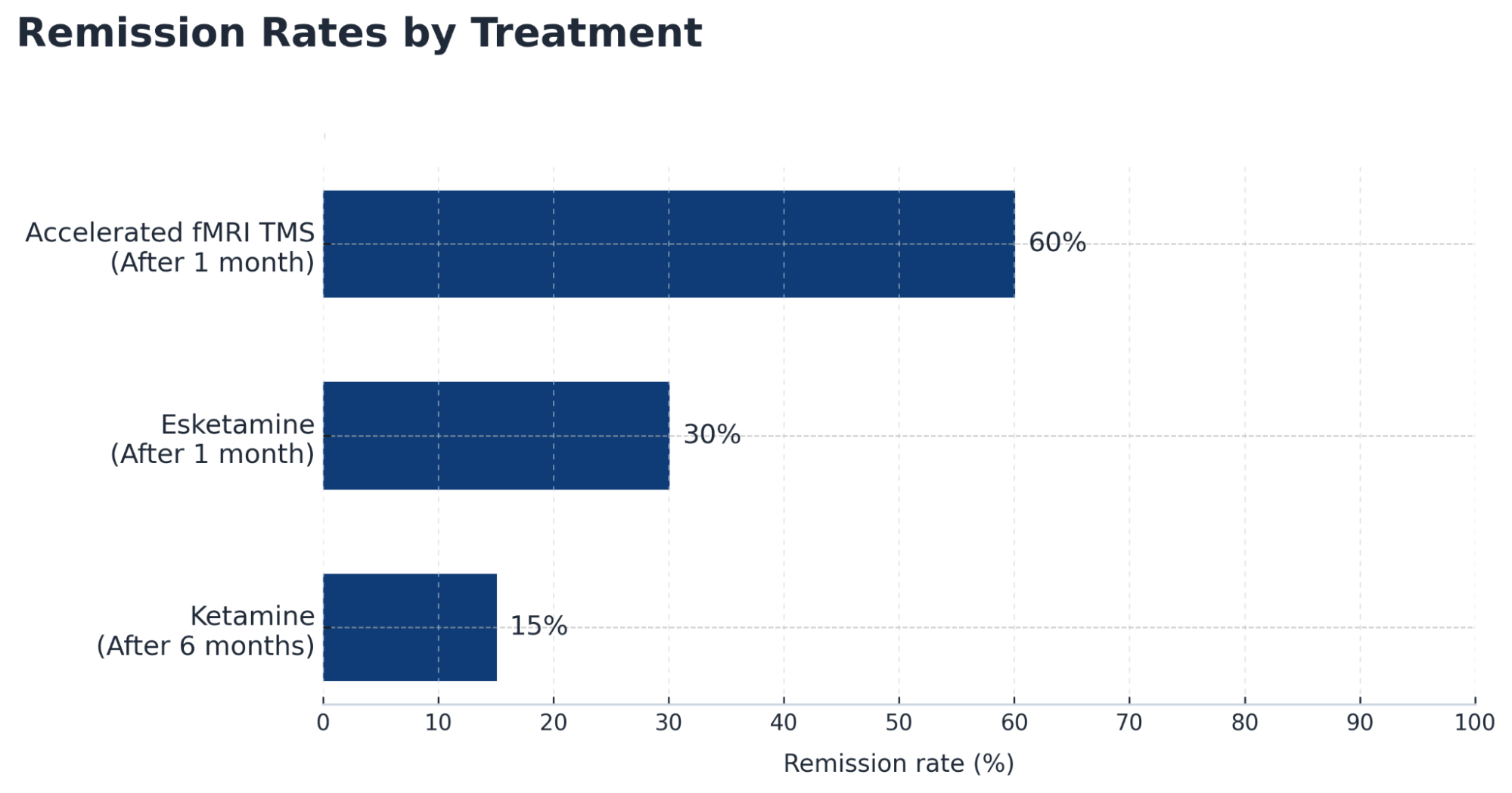
But ketamine’s effects tend to be transient. Most studies have shown that after six months and continued ketamine treatments, only 26% of patients were still responding and only 15% were in remission. Patients may find themselves chasing those early improvements, returning for ongoing infusions just to maintain relief.
Accelerated TMS, by contrast, is designed for lasting change, not temporary symptom relief. By directly engaging and retraining the brain’s mood-regulating networks, it helps establish new, stable patterns of neural activity rather than a fleeting chemical shift. Patients can complete treatment over the course of a single week, and many sustain significant improvement for months or longer—especially when psychotherapy continues afterward.
For psychologists, that difference matters. When the goal is sustained recovery and restored engagement in life and therapy, TMS provides a more stable foundation for long-term progress.
7. Accelerated TMS Has Limited Insurance Coverage (So Far)
While conventional TMS is now covered by most major insurers, coverage often comes with strict requirements—such as documented treatment resistance to multiple antidepressant medications and courses of psychotherapy.
New generation protocols, including forms of accelerated TMS and SAINT TMS, are still catching up in that regard. Insurance companies have been slow to recognize newer approaches, and coverage remains rare outside of hospital-based programs or research settings. A few exceptions exist: for example, Medicare and Medicaid may reimburse SAINT treatment when provided in specific hospital settings.
For many patients, that means paying out of pocket. While cost is a consideration, it’s worth noting that accelerated TMS delivers a full course of care in a single week and can produce rapid, lasting change—making it a worthwhile investment for those who can manage the expense.
Reflections From My Own Practice
In my 30+ years of psychology practice across clinical and academic settings, combining accelerated fMRI-guided TMS with CBT has been one of the most effective treatment combinations for treatment-resistant depression that I’ve seen.
At Cognitive FX, we’re now about a year into offering an alternative to SAINT™ that follows the same scientific principles—personalized, fMRI-guided targeting and FDA-approved neuronavigated theta burst stimulation—but at a significantly lower cost than other private clinics ($9,000–$12,000 vs. $30,000+).
So far, our patient outcomes are closely mirroring the remission and response rates reported in the original SAINT studies discussed above. If you’ve been exploring new options for your treatment-resistant depressed patients, want to understand how accelerated TMS can complement psychotherapy, or are curious about our work at Cognitive FX, I invite you to explore the resources below or reach out directly.
Further reading: