Soccer sends more players to our clinic than almost any other sport. Over the last two years, 102 people have contacted Cognitive FX after a soccer head injury, hoping someone could finally help. Most had already tried several kinds of care before reaching us and still had no answers.
Most of these players had been concussed more than once, four in ten of them four or more times, and just over half were women. Some reached out within a year of their latest injury. Others were years past it and still living with symptoms severe enough to be debilitating. Brain fog, headaches, and trouble concentrating led the list, each on at least three of every four forms, followed by fatigue, anxiety, and pressure in the head. Memory problems, light sensitivity, dizziness, and sleep trouble were common too, and many had lost the ability to keep up with school or work. For Sam Pembleton, hurt in a middle-school game, five years passed before anyone could help. "I was so isolated and I felt so hopeless," she said.
If this describes you or your child, you did not fail to recover. A concussion disrupts how the brain works, and that kind of dysfunction does not always heal on its own. It is a physical injury with a physical cause, and it can be treated.
You do not have to hit your head to concuss your brain. Sam's first soccer injury was a body check that snapped her head and neck without her skull ever making contact, and the whiplash alone was enough to start her symptoms. If you want the fuller picture of how soccer concussions happen, how to spot them, and how to prevent them, we cover that in our guide to soccer concussions.
If you or a loved one still have symptoms after a soccer head injury, see whether our treatment program is a good fit or call us at 385-446-4161.
Note: Six months after treatment, 77% of patients in an independent study had a meaningful reduction in symptoms. It was observational, and individual results vary. If your symptoms have lasted longer than six months, you may be a candidate. See if you qualify for a free consultation.
In this article:
When a Soccer Concussion Becomes Post-Concussion Syndrome
Most concussions heal and, within about two weeks, 80 to 90% of people who rest appropriately recover and return to normal life. However, 10 to 20% of patients are left with symptoms that persist for weeks, months, or years, a condition called post-concussion syndrome, or PCS.
Three things predict who ends up in that group:
- How many symptoms you had at the time of injury
- How long you have gone without recovering
- How many concussions you have had before
Competitive soccer players are often exposed to all three.
The culture of the sport is part of why soccer players reach that point. Many sports concussions go unreported, often because players hide symptoms to stay on the field. Molly, a goalkeeper, took hit after hit and kept playing, the way goalkeepers are expected to. By the time an injury is finally recognized, weeks or months have passed, and time without treatment is one of the factors working against recovery.
The longer symptoms go unaddressed, the more they tend to compound. Sam's symptoms worsened over five years. Melissa went from managing some of her schoolwork to not being able to function at all. Neither recovered by waiting.
Symptoms That Persist After a Soccer Concussion
Post-concussion symptoms rarely stay in one lane. They cluster across thinking, physical function, mood, and balance, and they feed into one another. Here is what that looked like for 102 real soccer concussion patients who reached out to our clinic over the last two years.
Cognitive symptoms are often the most disruptive to school and work. Sam had to read the same paragraph seven or eight times before it registered. Molly lost ground on working memory and verbal recall. Melissa could not finish school.
Physical symptoms and fatigue wear players down. Melissa slept twelve hours a day and still felt exhausted. Headaches were near-constant for several patients. Sam's light and noise sensitivity grew so severe that she kept a towel over her face to block out the world.
Emotional and psychological changes are also common. Madison's personality shifted, and the confidence she had always carried disappeared, replaced by anxiety and panic attacks. Sam's panic attacks were bad enough that she could not sit through dinner with her family.
Balance and visual problems round out the picture. Melissa got dizzy just watching television and struggled to drive, and strobe lights left her reeling. These vestibular and visual symptoms often travel together, because the systems behind them are closely linked. At her worst, Melissa also had episodes that looked like focal seizures.
Female players are concussed at higher rates than male players and often take longer to recover.
Why Standard Treatment Often Falls Short for Soccer Concussion Patients
Most of the soccer players who contact us have already been through the standard recovery playbook before they ever hear our name. By the time they reach us, many are carrying the exhaustion of being told, again and again, that nothing is wrong.
Of the 102 soccer players who have reached out over the last two years, only four had seen none of the usual providers first. Most had already worked through three or more kinds of care, and a handful had seen as many as eight. Family practice, physical therapy, and sports medicine are the common first stops, often followed by a neurologist.
The histories follow a familiar pattern, and so does the result. Rest comes first, and for most concussions it is enough. For PCS, it plateaus. Once the acute phase passes, more rest stops producing improvement, and players are left waiting for a recovery that never comes.
Physical therapy usually targets the neck. Sam's physio focused on the whiplash in her neck and, in her words, it did not make it better or worse. Neck work can ease neck pain, but it does not reach the brain dysfunction underneath the symptoms.
Neurologists order scans, and the scans come back clean. Melissa's CT was normal, and she was told to deal with it. Madison saw five different doctors and cycled through what she called endless medications, along with cortisone and steroid injections for neck support. Every one of them told her this was simply how her life would be now.
Specialized concussion clinics can help, but many treat one problem at a time. Sam spent a week at a clinic in Chicago that worked on a single brain region at a time and sent her home early when nothing improved. Care like this is often spread across providers who never speak to each other, scheduled weeks apart, with no one treating the brain as a connected system.
There is a deeper reason standard care falls short for these patients. It does not address the mechanism driving the symptoms.
When a region of the brain goes to work, it calls for an immediate increase in blood flow to supply the oxygen and glucose that effort demands. The tight coordination between brain activity and blood supply is called neurovascular coupling. A concussion can knock that coordination out of sync, so active regions no longer receive the right amount of blood at the right moment. The cells are intact, but they are not being supplied to meet demand, and the brain cannot perform the way it should. This is why symptoms can persist long after the injury itself has healed.
It also explains why a standard MRI or CT scan looks normal. Those scans capture the brain's structure, a still image of its anatomy. Neurovascular coupling is about function, how the brain responds while it is actually working, and a structural scan cannot see it. That is why so many soccer concussion patients are told their brain looks fine when it is not working fine.
Is It Too Late to Recover?
For players who are years out from their injury, this is usually the question that matters most. Many have already given up on the answer. Madison had, until her father kept searching and found a different kind of treatment. The honest answer has two parts.
Without treatment, recovery becomes less likely the longer symptoms last. In long-term follow-up, patients who were still symptomatic after three years did not go on to recover on their own.
With the right treatment, improvement is still possible years later. Patients who had been living with symptoms for about five years on average still had a meaningful reduction after treatment in an independent study. Being years down the line does not disqualify you. It is the reason to try something different from what has not worked so far.
If that describes you or your child, our good-fit quiz takes just a few minutes and will tell you whether treatment is likely to help.
How Cognitive FX Treats Soccer Concussion Patients
Our treatment starts by measuring the dysfunction that standard scans miss, then targets it directly.
The fNCI scan
Treatment begins with functional NeuroCognitive Imaging (fNCI), a specialized fMRI that measures blood flow across brain regions while you perform cognitive tasks. Because it watches the brain at work, it exposes the neurovascular coupling dysfunction directly and maps which regions are over- and under-active.;
A structural MRI is like a photograph of an orchestra, showing that every instrument is in its place. The fNCI is more like a recording that tells you whether the music is actually in tune. Your first scan becomes the roadmap for the week, and a second scan on the final day measures what changed. Sam's fNCI showed a 65.7 percent improvement by the end of her week, even though she had been so anxious that she had a panic attack during her first scan.
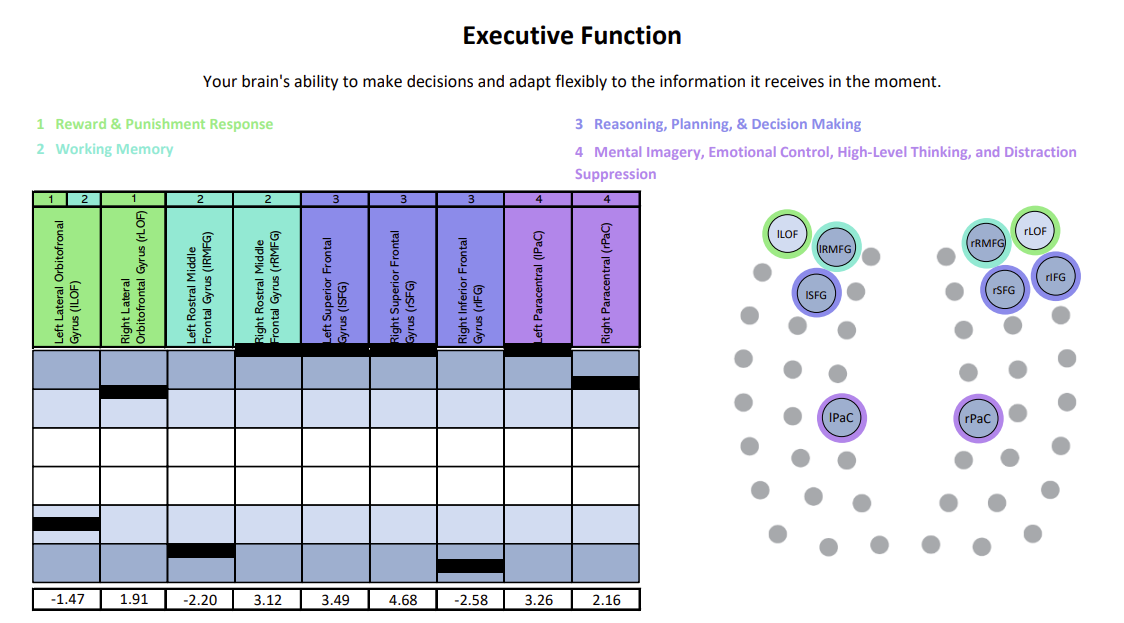
Each chart shows how specific brain regions are functioning compared to a normal brain. The white area represents the normal range, with the center line marking the average. Light and dark blue zones show increasing levels of abnormality. A black line marks the patient’s result for that region—ideally landing within the white. Lines in the light and dark blue zones suggest that region is either hyperactive (blue zones above the white) or hypoactive (blue zones beneath the white). In this example, the patient was experiencing both hypoactivity and hyperactivity within different key regions linked to executive function.
EPIC Treatment
EPIC treatment (Enhanced Performance in Cognition) follows a framework of Prepare, Activate, and Recovery.
The Prepare phase raises blood flow and primes the brain for change. The Activate phase is the most individualized part, directly targeting the regions the fNCI flagged. Recovery sessions are built in throughout the week. The exact mix of therapies is set by your scan rather than a fixed protocol, which is why no two treatment plans look alike. As Sam said of her own injury, "A concussion is like a fingerprint. It's unique for each person."
Across the patients in this article, several therapies stood out:
- Cognitive therapy rebuilt the skills soccer players tend to lose first. Molly's working memory and verbal recall moved back into normal ranges.
- Neuromuscular therapy eased the headaches, which Molly credited with much of her relief.
- Occupational and vision therapy addressed the balance and visual problems behind symptoms like Melissa's dizziness while watching television or driving.
- Psychological therapy supported the emotional toll, including the anxiety and personality changes Madison lived with for years.
What a Treatment Week Looks Like
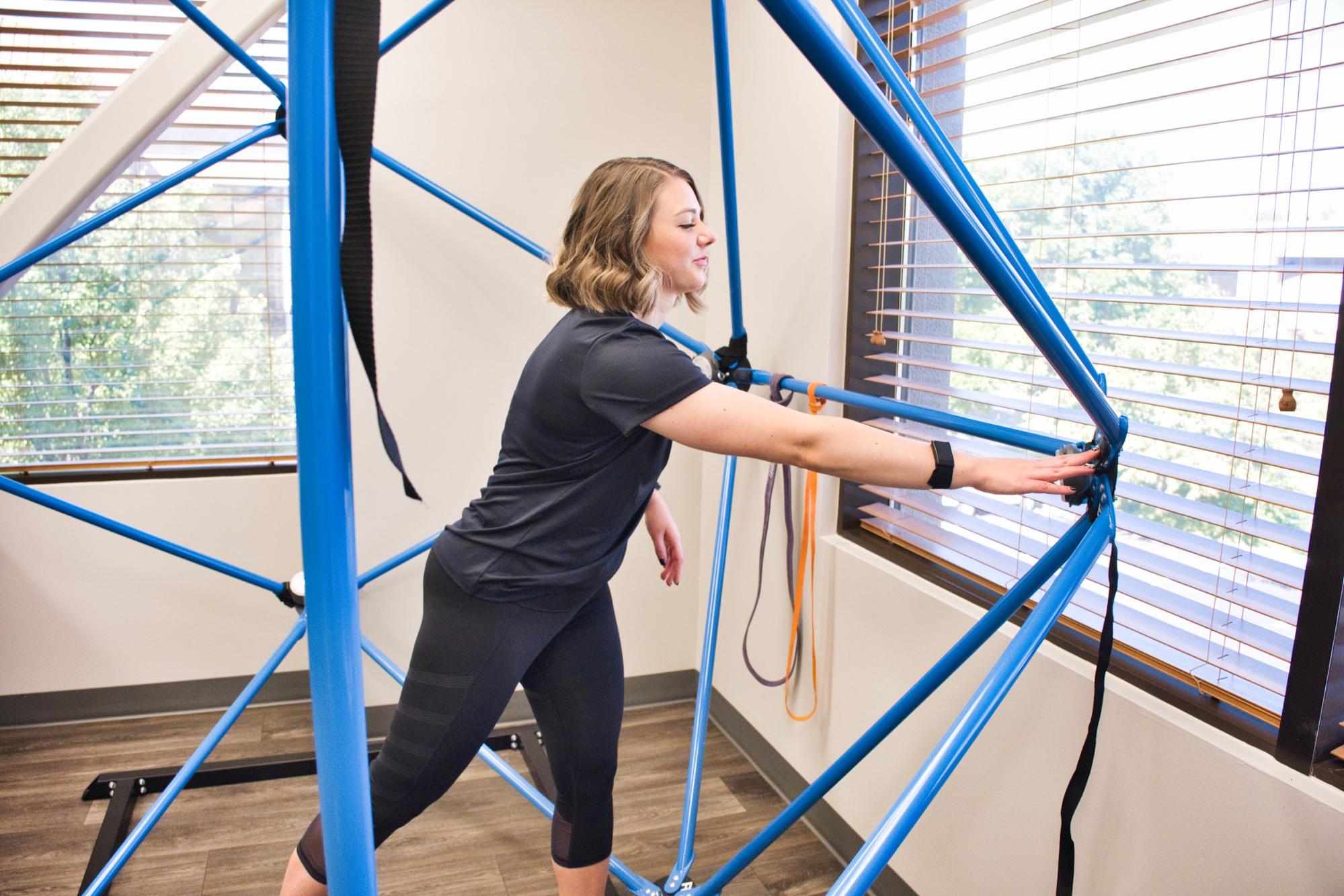
Patients often worry that an intensive week will feel vague or overwhelming. Melissa's week is a good picture of how it actually unfolds. Day one felt manageable. Day two left her exhausted. By day three, she was seeing things more clearly; the lights had stopped bothering her; her energy was climbing; and the nausea and headaches that had defined her days began to lift.
After Treatment
Recovery continues at home. Every patient leaves with a personalized program built around what worked during the week, and the care team follows up for months afterward. The gains tend to hold: in Cognitive FX's published research, improvements were still present at follow-up scans averaging nearly nine months after treatment.
Outcomes and Practical Details
Six months after treatment, 77 percent of patients in an independent study had a meaningful reduction in symptoms, along with improvements in anxiety, depression, fatigue, sleep, and vestibular and cognitive function. It was observational, and individual results vary. Treatment runs about a week, Monday through Friday, at our clinic in Provo, Utah. Cost ranges from $3,500 to $25,000 depending on each patient's needs. Most patients fly into Salt Lake City International, about 45 minutes away, or Provo Municipal, and stay at a partner hotel with patient rates and a shuttle to the clinic.
If you are not sure whether this is right for you or your child, a free consultation reviews your history, your symptoms, and whether you are a good fit, with no obligation.
Recovery Stories
The clearest picture of what recovery looks like comes from the players themselves.
Sam Pembleton spent more than five years cycling through treatments that did not work, including a week at a specialized clinic that sent her home early. After her week at Cognitive FX, she did her at-home program faithfully, and her headaches were completely gone about three months later. She went back to finishing high school, working, going to concerts, and planning for college. Her full story is worth reading in Sam's recovery story.
Melissa had been out of school for five years and sleeping half the day before treatment. Afterward, she talked about going back to school, working out again, and driving without the dizziness that used to make it frightening.
Molly described the clinic as a place where the staff were genuinely excited for her progress, and she made friends with other patients going through the same thing. On testing, she moved back into normal ranges.
Madison was blunt. "It worked for me," she said. She came out with new ways to process what she was going through and a different outlook on her own health, after five years of being told nothing would change.
Can You Return to Soccer After Post-Concussion Syndrome?
The step-by-step return-to-play protocol you may have read about is built for recent, acute concussions, guiding a player safely back over days or weeks. We cover that process in our soccer concussions article. It is a different question from returning after post-concussion syndrome that has already lasted for years.
For PCS, returning to soccer is an individual medical decision rather than a checklist. It depends on your injury history, how much brain function has recovered, and how much risk you and your doctors are willing to accept. For many patients, especially those with several concussions, the decision is not to go back. Molly said the concussions "knocked me out of the game forever," and Melissa does not plan to play contact sports again.
An fNCI can show whether your brain function has returned to normal ranges, which is useful information, but it does not by itself clear anyone to play.
What treatment reliably gives back is not the game. It is the rest of life. None of these players returned to competitive soccer, but they returned to school, work, driving, friendships, and the ordinary days that PCS had taken from them. For most people who have been struggling for years, that is the recovery that matters.
Are You (or Your Child) a Candidate for Treatment?
If you have been told your scans are normal and you are fine, but you know you are not, you are the kind of patient we see every week. A few guidelines can help you judge whether our treatment is likely to fit.
You are likely a good candidate if symptoms have lasted six months or more without improvement, or if you have had multiple concussions with severe symptoms, even if it has been less than six months. Players with a single recent concussion who are under six months out are usually better served by continuing local care first, then reaching out if symptoms have not resolved by the six-to-nine-month mark.
If your symptoms, or your child's, have lasted six months or more with no real improvement, you may be a good fit for treatment. See if you qualify with a free consultation, take our good-fit quiz, or call us at 385-446-4161.
Relevant and Cited Research
- National Research Council and Institute of Medicine. Sports-Related Concussions in Youth: Improving the Science, Changing the Culture. National Academies Press, 2014. Link
- Hiploylee C, Dufort PA, Davis HS, Wennberg RA, Tartaglia MC, Mikulis D, Hazrati LN, Tator CH. Longitudinal Study of Postconcussion Syndrome: Not Everyone Recovers. Journal of Neurotrauma, 2017;34(8):1511–1523. Link
- Register-Mihalik JK, et al. Knowledge, Attitude, and Concussion-Reporting Behaviors Among High School Athletes: A Preliminary Study. Journal of Athletic Training, 2013;48(5):645–653. Link
- Covassin T, Moran R, Elbin RJ. Sex Differences in Reported Concussion Injury Rates and Time Loss From Participation: An Update of the NCAA Injury Surveillance Program From 2004–2005 Through 2008–2009. Journal of Athletic Training, 2016;51(3):189–194. Link
- Sharma A, Hind K, Hume P, Singh J, Neary JP. Neurovascular Coupling by Functional Near Infra-red Spectroscopy and Sport-Related Concussion in Retired Rugby Players: The UK Rugby Health Project. Frontiers in Human Neuroscience, 2020;14:42. Link
- Yan J, Huang W, Xu L, Xu K, Jiang L, Chang M, Zhang J. Neurovascular Coupling Dysfunction of the Frontal–Thalamic Circuit in Postconcussion Syndrome. Brain Imaging and Behavior, 2026. Link
- Wing BH, Tucker BJ, Fong AK, Allen MD. Developing the Standard of Care for Post-Concussion Treatment: Neuroimaging-Guided Rehabilitation of Neurovascular Coupling. The Open Neuroimaging Journal, 2017;11:58–71. Link
- van Doorn E, Oosterlaan J, van der Naalt J, Groenewold R, Visser A, Verheij N, Klappe E, Kool A, Lindhout M, Algra PR, Königs M. Cognitive FX-behandeling voor aanhoudende klachten na een hersenschudding: Observatie van verandering in functioneren [Cognitive FX treatment for persistent symptoms after concussion: observation of change in functioning]. Tijdschrift voor Neuropsychologie, 2024;19(2):110–138. Published in Dutch. Link
Further Reading