Many patients who consider or undergo transcranial magnetic stimulation (TMS therapy) want to understand how this treatment affects their brains.
Here's the honest version. TMS does change the brain, and researchers can measure those changes. But the changes are functional, not structural, and at the individual level, the imaging doesn't yet produce the clean before-and-after picture most people are hoping to find. That gap between what clinic marketing sometimes implies and what the science actually supports is worth understanding before you start.
This article covers what the depressed brain looks like before TMS, what changes after, how those changes connect to how you feel, and why TMS imaging works differently from imaging for conditions like concussion.
Below, we cover:
Cognitive FX offers fMRI-guided accelerated TMS for treatment-resistant depression, with ~79% remission rates using precision targeting. Take our short quiz to see if you're a good fit, or call 385-334-6093 to speak with someone directly.
What the Depressed Brain Looks Like Before TMS
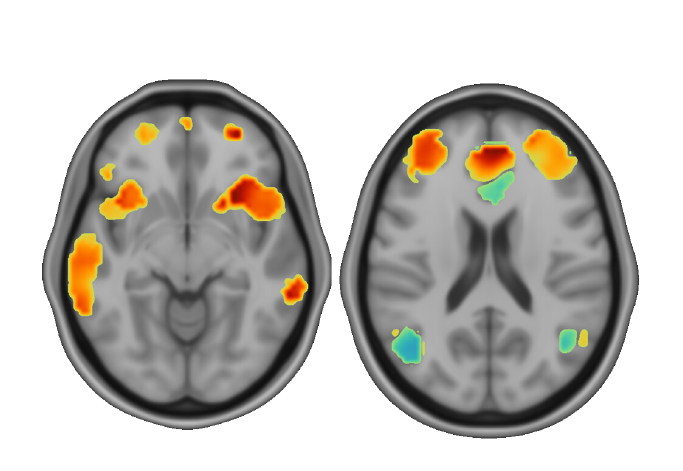
Major depressive disorder isn't just a chemical imbalance. It's a pattern of disrupted activity in the brain circuits that regulate mood. Three findings show up consistently when researchers compare depressed and non-depressed brains:
- The left dorsolateral prefrontal cortex (DLPFC) shows reduced activity. This region acts as a regulatory brake on negative thinking and rumination. In depression, that brake weakens, and TMS targets this specific area with excitatory stimulation to restore it.
- The default mode network runs too loud. This network is active when the mind isn't focused on a task. In depression it tends toward rumination, including replaying failures and generating worst-case thinking.
- Connectivity between regions becomes dysregulated. Depression is partly a communication problem between areas of the brain, not a deficit in any single one.
A standard MRI of a depressed brain looks normal. The differences are in activity patterns, which only show up on functional imaging like fMRI. More on this below.
What TMS Actually Does to the Brain
TMS works by delivering magnetic pulses through the scalp, generating brief magnetic fields that induce small electrical currents in a specific part of the prefrontal cortex (L-DLPFC). Those currents increase blood flow in the region and boost neurotransmitter activity. Nothing foreign enters the brain. TMS activates biological processes that are already there.
The intermittent theta burst stimulation (iTBS) protocol makes this particularly clear. It delivers magnetic pulses in the same rhythm the brain naturally produces during learning and memory consolidation. The brain recognizes the signal as its own.
The impact extends beyond the DLPFC and reaches deeper structures through the brain's existing wiring. A 2024 NIMH-funded study found that stimulating a surface target reliably changed activity in the subgenual anterior cingulate cortex, a deeper region tied to depression. Participants saw a 34% improvement in depression symptoms after three days, with imaging confirming the deeper change.
You may have seen TMS described as a way to "reorganize" the brain. That framing is misleading. TMS doesn't restructure a healthy brain. It gives a disorganized brain the conditions to consolidate back toward how it's designed to work.
What Brain Imaging Shows After TMS
The findings below come from research studies comparing groups of patients before and after TMS, averaged across many people. They describe real changes, but identifying what happens for each individual patient is harder.
A 2022 fMRI study found that after repetitive TMS (rTMS), brain activity increased in the left superior frontal gyrus, a region that had been underactive before treatment. Activity also decreased in regions that had been hyperactive. TMS adjusts both directions, not just one.
Connectivity also improves. A 2023 meta-analysis of multiple imaging studies confirmed consistent activity changes across the precentral gyrus, posterior cingulate, and frontal regions following TMS for depression. Mood-regulating regions start communicating again.
What doesn't change is worth noting. No shrinkage. No lesions. No structural alteration. The brain's architecture is identical before and after. Only function is recalibrated, and that functional shift is what produces symptom relief.
These group-level patterns are reliable. Whether your own scan would show a clean before-and-after change is a separate question, and an honest answer to it follows in the imaging section below.
How Brain Changes Connect to How You Feel
Research describes brain regions in clinical terms. Patients describe feelings. Most articles never connect the two. Here's the bridge, based on what tends to happen across patients.
- DLPFC recovery: When TMS restores its activity, mental flexibility often returns, and rumination becomes easier to interrupt.
- Default mode network quieting: When this network is overactive, you get stuck in thought loops and replayed failures. When TMS reduces that overactivity, stopping the replay becomes possible again.
- Improved connectivity: When neural connectivity is disrupted, there's a gap between knowing something rationally and feeling it—like knowing you're loved but not being able to really feel it. When connectivity strengthens, the rational and emotional begin to align.
Why TMS Imaging Isn't Like Brain Injury Imaging
Patients sometimes ask whether a scan can show TMS working the way it shows recovery from a concussion. The short answer is no, and the reason is worth understanding.
With a brain injury, the changes in brain activity are large relative to normal variation. They can be measured and mapped for each individual. Cognitive FX uses functional neurocognitive imaging (fNCI) for exactly this in concussion patients, producing individual before-and-after pictures. The signal is strong enough to stand out from the noise of natural individual differences.
Depression imaging is more subtle. TMS works by adjusting how brain regions regulate each other, not by turning a single area up or down. Researchers can measure changes in the timing and direction of signals between regions, but those changes vary from person to person and are smaller than the natural differences between individuals. Pointing to one scan and saying "this is what treatment did" for any single patient is not yet reliably possible.
This is why TMS effectiveness is measured through validated symptom scales—the Hamilton Depression Rating Scale, PHQ-9, and MADRS—rather than imaging. These are the same tools used in every credible TMS clinical trial.
The absence of dramatic individual scans reflects where the science is, not a failure of the treatment. Be skeptical of any clinic that implies otherwise. For TMS, imaging plays a different role than it does for concussion. It's most useful for targeting before treatment.
What a Pre-Treatment Scan Can Predict
While post-treatment imaging doesn't yet produce clean individual before-and-after pictures, pre-treatment fMRI does have a useful role: identifying the best stimulation target for each patient.
The DLPFC isn't one spot on the skull. Its exact location varies from person to person, and the subregion most connected to mood regulation varies too. Standard TMS clinics estimate the target using a scalp landmark. fMRI-guided targeting finds the specific location based on each patient's actual brain activity, typically within 1–2mm accuracy.
Research also shows that connectivity patterns visible on a pre-treatment fMRI can help predict who is most likely to respond. Patients whose DLPFC shows stronger connectivity to the subgenual anterior cingulate cortex before treatment tend to show larger gains. That's an area of active research, not a standard clinical tool yet, but it points toward a future where pre-treatment imaging does more than just locate the target.
Will TMS Change Who I Am?
This question comes from two opposite directions.
Some patients fear changing too much, essentially becoming a different person. TMS restores function in mood-regulation circuits. It doesn't affect the regions tied to personality, identity, or core memory. The version of you that depression has suppressed is what surfaces.
Other patients, worn down by years of treatment-resistant depression and failed antidepressant medications, hope for a total transformation. TMS doesn't create new capacities. It restores access to the ones depression dampened. The lift can be significant, but it returns you toward who you were before depression took hold.
Both the fear and the hope overestimate how transformative TMS is and underestimate how meaningful it is.
Related Read:“I suddenly realized I hadn’t felt that cloud in days. Smiling was easier. Laughing was easier. It just crept up on me—and then it felt like the sun just broke through.” – Cognitive FX Patient Story: 9 Years of Depression Finally Lifted
What Patients Actually Notice
Since individual imaging can't show you a clean picture of your own response, what you notice in yourself is how you'll know TMS worked.
- Mood: Standard rTMS improves mood gradually over four to six weeks of treatment, while accelerated fMRI-guided iTBS protocols often produce shifts within the five-day treatment course.
- Cognition: Cognitive function often improves alongside mood. A randomized controlled study found measurable gains in attention, working memory, and executive function after rTMS for treatment-resistant depression.
- Timing: Some patients feel worse before they feel better. Roughly 20–25% experiencethe TMS dip—a temporary worsening before improvement consolidates. It's usually a sign the brain is responding to stimulation, not that something has gone wrong.
What TMS Feels Like and Its Side Effects
The side effects patients experience are short-term and mild: headache, scalp discomfort, jaw clenching, and a tapping sensation during each session. These come from the trigeminal nerve being activated by the magnetic coil near the scalp, not from anything happening in the brain.
Serious side effects are rare. The most significant is seizure, occurring in fewer than 1 in 10,000 treatment sessions and almost always in patients with risk factors that medical screening should catch. Motor threshold is measured at the start of treatment to set the magnetic field intensity safely. There is no known neurological mechanism by which TMS damages tissue; the neural excitation it produces is the same process the brain uses during learning.
TMS is a non-invasive treatment delivered in an outpatient setting, with no anesthesia and no memory loss. That's a meaningful difference from electroconvulsive therapy (ECT), the other major brain stimulation option for severe depression. The two are sometimes confused, but the differences between TMS and ECT are substantial.
How Cognitive FX Maps Your Brain First
Most TMS clinics estimate the location of the DLPFC using a scalp landmark called the "5-cm rule." Coil placement can drift by up to 2cm from session to session. That imprecision doesn't cause harm, but it helps explain why standard rTMS achieves remission in only about 30% of patients. TMS only changes the brain where the magnetic field lands. If the target is off, the treatment can't do its job. And unlike with concussion, there's no post-treatment scan to confirm whether the right spot was hit.
Cognitive FX's accelerated fMRI-guided TMS directly addresses the targeting problem. Before any stimulation, a functional MRI maps each patient's individual brain activity to locate the stimulation target within 1–2mm. FDA-approved neuronavigation then keeps the coil on that exact spot across all 50 TMS sessions of the five-day course.
The TMS protocol used is an off-label alternative based on the Stanford SAINT™ trial, using the same dosage, schedule, and iTBS delivery, with fMRI analysis done in-house by Cognitive FX's neuroscientist and physician. (SAINT™ is a trademark of Stanford University, licensed exclusively to Magnus Medical. Cognitive FX is not affiliated with Magnus Medical and does not use their equipment or software.)
Cognitive behavioral therapy is built into the treatment week, which studies have shown improves remission rates by about 19% compared to TMS alone. For patients who need them later, booster sessions reuse the original fMRI targeting data, and a booster day is included in initial pricing.
The program runs $7,000 to $12,000, compared to $30,000 or more for the licensed Magnus SAINT™ product. Standard rTMS is covered by most major insurers for qualifying patients, while the accelerated protocol is self-pay. Cognitive FX treats adults aged 18 to 65 with major depression or treatment-resistant depression who haven't found relief from at least two antidepressant medications. Patients with a seizure history, metallic implants near the treatment site, or who are in active crisis are not appropriate candidates.
If you've tried antidepressant medications and therapy without enough relief and want to know exactly where TMS would target in your brain before treatment begins, Cognitive FX's accelerated fMRI-guided TMS starts with an individualized brain map. Take our TMS quiz to see if you're a candidate, or schedule a free consultation. You can also call 385-334-6093 to speak with someone directly.
Further Reading
Relevant and Cited Research
- Guan M, Wang Z, Shi Y, et al. Altered Brain Function and Causal Connectivity Induced by Repetitive Transcranial Magnetic Stimulation Treatment for Major Depressive Disorder. Frontiers in Neuroscience. 2022. PMC8964457
- Deng Y, Li W, Zhang B. Functional Activity in the Effect of Transcranial Magnetic Stimulation Therapy for Patients with Depression: A Meta-Analysis. Journal of Personalized Medicine. 2023;13(3):405. PMC10051603
- Oathes DJ, Balderston NL, Kording KP, et al. Noninvasively Stimulating Deep Brain Areas to Treat Depression Symptoms. Nature Mental Health. 2024. 1, 1033–1042.
- Cole EJ, Phillips AL, Bentzley BS, Stimpson KH, et al. Stanford Neuromodulation Therapy (SNT): A Double-Blind Randomized Controlled Trial. American Journal of Psychiatry. 2022;179(2):132–141.
- Huang YZ, Edwards MJ, Rounis E, Bhatia KP, Rothwell JC. Theta burst stimulation of the human motor cortex. Neuron. 2005;45(2):201–206.
- Yildiz T, Oguzhanoglu NK, Topak OZ. Cognitive outcomes of transcranial magnetic stimulation in treatment-resistant depression: a randomized controlled study.Turkish Journal of Medical Sciences. 2023. PMC10387879
- Donse L, Padberg F, Sack AT, Rush AJ, Arns M.Simultaneous rTMS and psychotherapy in major depressive disorder: clinical outcomes and predictors. Current Opinion in Psychiatry. 2019;32(5):422–429.
- Mesquita R, Faseyitan O, Turkeltaub P et al. Blood flow and oxygenation changes due to low-frequency repetitive transcranial magnetic stimulation of the cerebral cortex. J Biomed Opt. 2013;8:067006