If you took hits playing football and still don't feel like yourself, even after you’ve been cleared to play and told your scans look normal, you are not imagining it, and you are not alone.
Between October 2024 and October 2026, 95 people hurt playing football filled out our intake paperwork, hoping someone could finally help. Of the 90 who told us how many head injuries they’d had, 48 reported four or more. Almost half told us their symptoms were getting worse, and only two said they were getting better. They ranged from high school players to men who had stopped playing decades ago.
Jacob Ponce knows how this starts. With two minutes left in the first game of his senior year, he woke up at the bottom of a pile, confused, after being knocked out cold. He kept playing because his team was facing the best team in the state, and he didn't want to let them down. He now says he is horrified that he stayed on the field.
Often it is someone else who notices first. Christian's mom was the one who found Cognitive FX after a few high school concussions left him exhausted by ordinary homework. When Austin Collie called his wife from the locker room after a hit in an NFL game, he told her he was fine. She later told him she couldn't understand a word he'd said.
Repeated concussions can leave the brain working less efficiently than it should, and that kind of dysfunction does not always heal with rest. It is a physical injury with a physical cause, and it can be treated, even years after the last hit.
In this article we’ll cover:
If you want the fuller picture of how football concussions happen, how to spot them, and how to prevent them, we cover that in our guide to football concussion prevention and recovery.
If you or someone you love still has symptoms after a football head injury, see whether our treatment program is a good fit or call us at 385-446-4161.
Note: Six months after treatment, 77% of patients in an independent study had a meaningful reduction in symptoms. It was observational, and individual results vary. If your symptoms have lasted longer than six months, or you've had several concussions, you may be a candidate. See if you qualify for a free consultation.
When a Football Concussion Becomes Post-Concussion Syndrome
Within about two weeks, 80 to 90% of people who rest appropriately recover from a concussion and return to normal life. The remaining 10 to 20% are left with symptoms that last for weeks, months, or years, a condition called post-concussion syndrome, or PCS.
Three things predict who ends up in that group:
- How many symptoms you had after the injury
- How long you have gone without recovering
- How many concussions you have had before
Symptom count matters more than most people expect. In long-term follow-up of PCS patients, each additional symptom slowed the rate of recovery by roughly 20%. Prior concussions are where football players stand out.
Football Players Commonly Sustain Multiple Concussions
Of the 90 football players who told us how many head injuries they'd had, 48 reported four or more. That is the highest share of any group of patients we have profiled. The share climbs with age. Among players under 18, 21% had four or more head injuries. Among those aged 18 to 34, it was 60%. Among the 13 former players aged 50 and older, 10 had four or more.
Football players take contact several days a week, in practice as well as games. Jacob's last hit came in practice. Austin Collie had three concussions in less than two years with the Colts, including one where his head slammed into the turf two weeks after he had passed concussion protocol. Christian had a few concussions in high school football and was still feeling them when his family brought him to us.
Many players also play a second contact sport. Twenty-eight of the football players who reached out to us also named another one, such as wrestling or hockey. Jacob wrestled too. For a high school athlete who goes straight from football season into wrestling season, the brain may never get a stretch of time without contact.
Why Players Feel Pressure to Play Through Concussions
Jacob stayed in the game after being knocked out. A week later, he was cleared to play. He has no memory of that game. Three days later, he took another blow to the head in practice, and he knew immediately that something was seriously wrong. Doctors later classified his injury as second impact syndrome, a rare and dangerous injury that happens when the brain takes another hit before it has healed from the first. He never played football again.
Football's weekly schedule pushes players back fast. There is a game every Friday or Saturday, and a concussion that keeps a player out for three weeks can cost a third of a high school season. The stakes go up from there. Jacob lost his scholarship opportunities along with the sport. Austin was heading into a contract year as the Colts' No. 2 receiver. After his injuries, teams began to see him as a player who couldn't stay healthy, and he spent the rest of his career trying to prove he could play without another head injury. He has said that pressure took the fun out of the game.
When players hide symptoms, many concussions are never counted. In interviews with college football players, athletes averaged more than two concussions during their careers but had been diagnosed and treated for barely more than one. The players described pressure from teammates and a fear of being seen as soft. A similar gap showed up in our intake data. Of the 37 players who answered the question, 15 had never had a scan or test of any kind for their head injuries.
The habit of playing through symptoms carries a long-term cost. In the follow-up of PCS patients mentioned above, the players who did not recover were more likely to have ignored advice not to return to play.
Common Symptoms That Persist After Football Concussions (According to Real Players)
Post-concussion symptoms rarely stay in one category. They spread across thinking, energy, mood, and the body, and they make each other worse. Here is what 79 football players who completed our symptom checklist reported.
We cover several of these in more depth, including brain fog, post-concussion headaches, and sleep problems.
Fatigue is often the symptom nobody can explain. Christian was tired all the time. Homework wore him out, and so did ordinary tasks that never used to cost him anything. He saw a doctor to figure out why, and they couldn't find an answer. For athletes, fatigue often shows up as exercise intolerance as well, which we cover in our guide to exercising after a concussion.
Cognitive symptoms tend to show up first at school or work. Jacob went from a 4.0 student to someone who couldn't get through a class without a migraine. He also struggled with speech and with his vision.
Mood changes are among the most common symptoms we see in football players. Three in four reported anxiety or irritability, and nearly half reported depression. Jacob described severe mood swings. In men, irritability often shows up as a short temper, and partners and parents often notice it before the player does.
Sixty-two percent of the football players we heard from rated the impact on their daily life at 8 or higher out of 10. Forty-three percent said their symptoms were getting worse over time. Jacob spiraled for months after his last hit before settling at what he called a low quality of life.
"Is This CTE?"
Football puts concussions under a brighter public spotlight than most sports, and many former players with lingering symptoms eventually ask this question. Austin Collie heard it constantly. People texted, tweeted, and emailed him about his head, and the headlines predicted he would have "dementia by the time he's 40." He felt the decision about his future belonged to him and his family.
Jacob now works as a clinical research coordinator at a sports brain bank that studies chronic traumatic encephalopathy (CTE). As he explains, CTE can only be diagnosed after death, by examining the brain directly. Researchers have developed criteria for the clinical syndrome linked to CTE, but those criteria are meant for research. They also require symptoms that progress over time and that no other condition fully explains.
Nobody can tell a living player whether he will develop CTE. Many of the symptoms football players fear most, including memory problems, irritability, depression, and brain fog, are also symptoms of post-concussion syndrome. Our article on the differences between PCS and CTE explains how the two compare. Unlike CTE, PCS can be measured in a living brain, and it can be treated.
Why Standard Treatment Often Falls Short for Football Players
Football players who contact us tend to fall into two groups. The first has already worked through the usual care. Forty-five percent had seen three or more kinds of providers before reaching us, most often a family doctor, a physical therapist, a sports medicine clinician, or a neurologist. The second group never got into the system at all. Seventeen of the 95 football players had seen none of the usual providers.
The three players in this article all went through standard care first.
Christian's family took him to a doctor to find out why he was so tired. The doctor tried to work it out and couldn't. Nothing he was told explained why homework left a high school athlete exhausted.
Austin Collie did everything he was supposed to do. After each concussion he rested until his symptoms were gone and passed the standard protocol. He saw every doctor he could, and they all told him that everything looked good and that they saw no problem with him playing. He has said that players retiring early over concussions often get only the same advice to rest, wait for the symptoms to fade, and accept that nobody knows what will happen. Rest helps in the first days after a concussion, but there are better ways to treat a concussion once symptoms linger.
Jacob was cleared by that same process a week after being knocked out, and he was hit again three days later. Afterward, he enrolled in college believing that if he stayed away from sports, he would eventually recover. He later called that belief a pipe dream. Two years after his last injury, he was still stuck.
Sports concussion clinics do important work, but most are built for the days and weeks after an injury. They diagnose the concussion, track symptoms, and decide when a player can safely return to practice. That process answers whether a player is ready to play. It was never designed to answer why a player is still struggling a year later.
There is a deeper reason standard care falls short for these players. It does not measure or address the problem driving their symptoms.
When a region of the brain goes to work, it calls for an immediate increase in blood flow to supply the oxygen and glucose that effort demands. The tight coordination between brain activity and blood supply is called neurovascular coupling. A concussion can knock that coordination out of sync. Active regions stop receiving the right amount of blood at the right moment, so the brain cannot function as it should. This is why symptoms can persist long after the injury itself has healed.
It also explains why Christian's workup and Austin's scans looked normal. A standard MRI or CT scan captures the brain's structure, a still image of its anatomy. Neurovascular coupling is about function, how the brain responds while it is actually working, and a structural scan cannot see it. That is why so many football players are told their brain looks fine when it is not working fine.
Is It Too Late to Recover?
For players who are years out from their last hit, this is usually the question that matters most. Jacob was asking it two years after his final injury, nearly hopeless, with no plan that was working. Many of the football players who contact us are further out than that. Of the 27 who gave us a date, 12 were injured more than five years before they reached out, and 15 of the 95 are 50 or older.
The honest answer has two parts.
Without treatment, recovery becomes less likely the longer symptoms last. In long-term follow-up of PCS patients, no one whose symptoms had lasted three years or more went on to recover. Jacob's plan of waiting it out rarely works once symptoms have settled in.
With the right treatment, improvement is still possible years later. Participants in an independent study of our treatment had been living with symptoms for nearly five years on average, and 77% had a meaningful reduction in symptoms afterward. Being years down the line does not disqualify you. It is the reason to try something different from what has not worked so far.
If that describes you or your loved one, our good-fit quiz takes a few minutes and will tell you whether treatment is likely to help.
How Cognitive FX Treats Football Players with PCS
Our treatment starts by measuring the dysfunction that standard scans miss. Then it targets that dysfunction directly.
The fNCI Scan
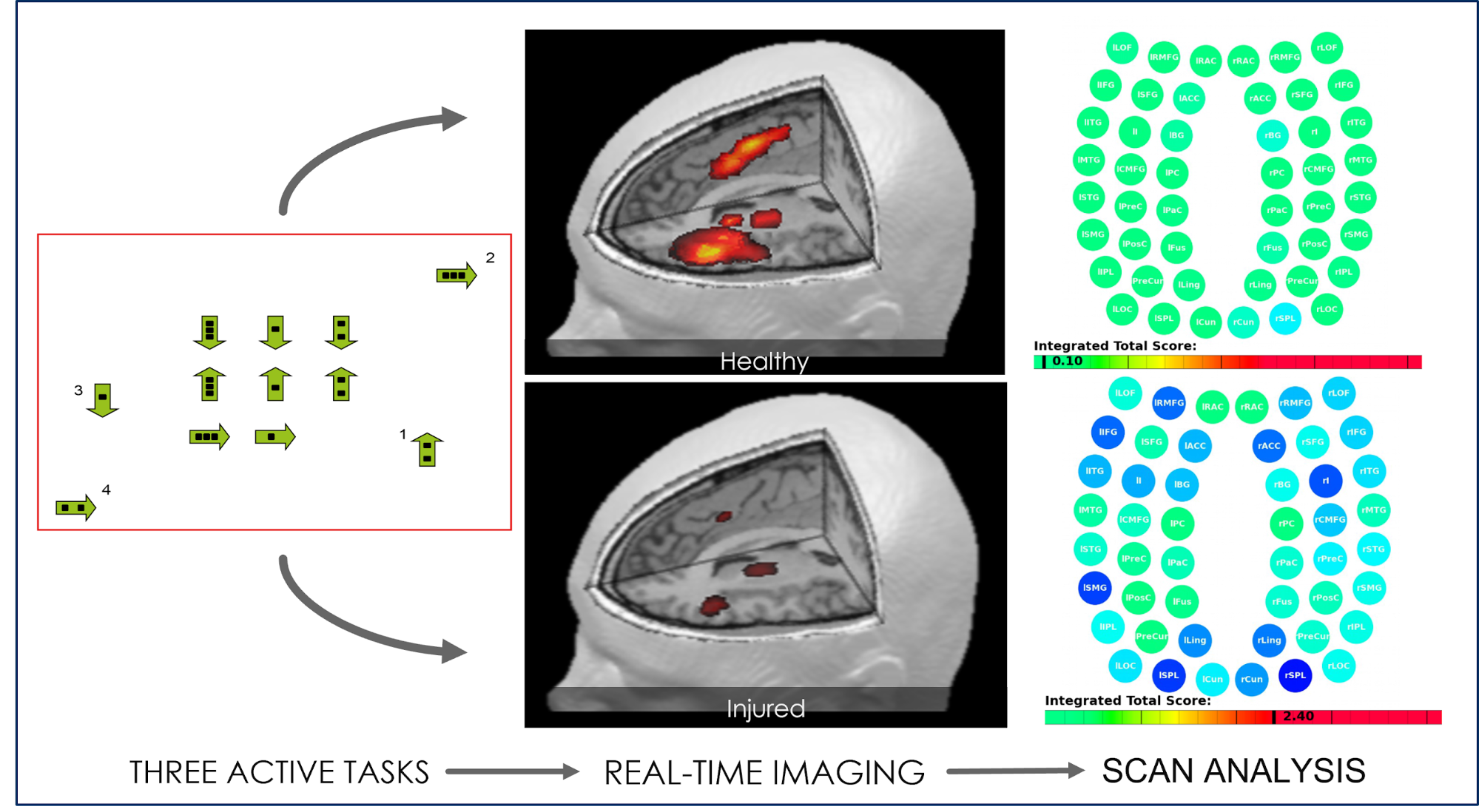
How the scan works: cognitive tasks in the scanner, real‑time imaging, then analysis against a normative database.
Treatment begins with functional NeuroCognitive Imaging (fNCI), a specialized fMRI that measures blood flow across brain regions while you perform cognitive tasks. Because it watches the brain at work, it shows which regions are over-active and which are under-active.
Your first scan becomes the roadmap for the treatment week, and a second scan on the final day measures what changed.
Austin Collie, who later joined our staff, came to us because he wanted that kind of evidence. He knew a standard MRI only showed structural damage, and he wanted to know how his brain was functioning. His reasoning was an athlete's reasoning. Athletes would rather find their weaknesses than their strengths, he has said, because weaknesses are what you can work on.
Christian's scan showed that he was moderately impaired. For a high school student whose doctor couldn't explain his exhaustion, it was the first concrete answer. Jacob's scan led to a treatment plan targeted to his brain, and it showed him he was functioning better than he had feared.
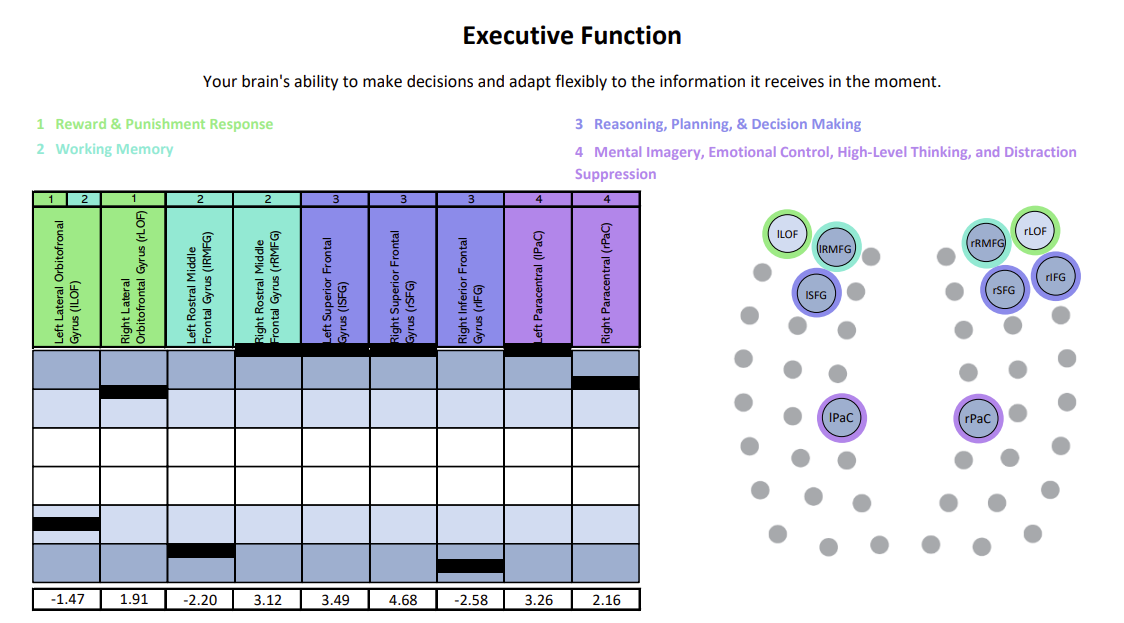
Each chart shows how specific brain regions are functioning compared to a normal brain. The white area represents the normal range, with the center line marking the average. Light and dark blue zones show increasing levels of abnormality. A black line marks the patient’s result for that region—ideally landing within the white. Lines in the light and dark blue zones suggest that region is either hyperactive (blue zones above the white) or hypoactive (blue zones beneath the white). In this example, the patient was experiencing both hypoactivity and hyperactivity within different key regions linked to executive function.
EPIC Treatment and the Treatment Week
EPIC Treatment (Enhanced Performance in Cognition) runs Monday through Friday for about six to nine hours a day. For a football player, the closest comparison is training camp. It is demanding, and every session is built around the specific weaknesses the fNCI scan found.
The week follows a framework of Prepare, Activate, and Recover. The Prepare phase raises blood flow and primes the brain for change. The Activate phase is the most individualized part, directly targeting the regions the fNCI flagged. Recovery sessions are built in throughout the week so you can keep working without overloading.
Christian described his week as a series of exercises aimed at bringing the regions that were over-active or under-active back toward normal levels. The exact mix of therapies is set by each patient's scan, which is why no two treatment plans look alike. For the symptoms football players report most often, several therapies do much of the work:
- Cognitive therapy, delivered by speech-language pathologists, rebuilds attention, memory, and executive function, the skills behind the difficulty concentrating that 78% of football players reported.
- Neuromuscular therapy works on the neck, balance, and blood flow, and it often eases persistent headaches.
- Occupational and vision therapy address the eye-tracking and visual problems that Jacob lived with.
- Psychological therapy addresses anxiety, irritability, depression, and the loss of identity that can come with losing the game.
Some exercises are competitive by design. Austin spent time at the clinic taking patients through a large board of flashing lights that trains hand-eye coordination and thinking at the same time. Scores are tracked, so patients compete against their own best results and against each other. Austin has said patients love it, and the competition suits athletes.
After Treatment
Recovery continues at home. Every patient leaves with a personalized program built around what worked during the week, and the care team follows up for months afterward. Christian valued that most. He left with direction and exercises he could keep doing, so his recovery didn't feel like a one-time fix that would wear off.
Recovery doesn't always move in a straight line. Jacob was making steady progress when he was rear-ended on a go-kart track and concussed again. It was a crushing setback after he had given up contact sports. He kept going, and he describes that period as the point where he decided to turn his injury into something meaningful.
Outcomes and Practical Details
Christian went from moderately impaired to the normal range on his fNCI within a week. That was his result, and individual results vary. In the independent study, 77% of patients had a meaningful reduction in symptoms six months after treatment. Depression, fatigue, anxiety, and sleep all improved, and scores on timed tests of attention and processing speed moved into the normal range. The study was observational and had no comparison group.
Treatment takes place at our clinic in Provo, Utah. Cost ranges from $3,500 to $25,000 depending on each patient's needs (see pricing). Most patients fly into Salt Lake City International, about 45 minutes away, or Provo Municipal, and stay at a partner hotel with patient rates and a shuttle to the clinic.
For players who are still competing, treatment takes one week and can be scheduled in the offseason.
If you're not sure whether this is right for you, a free consultation reviews your history, your symptoms, and whether you are a good fit, with no obligation.
Recovery Stories from Football Players at Our Clinic
The clearest picture of what recovery looks like comes from the players themselves.
Christian came to us because his mom kept looking for answers after his doctor ran out of them. After a week of treatment and a review of his results with Dr. Fong, he left with a brain that tested in the normal range and a plan to keep improving at home. He said he felt happier and more confident in his ability to handle everyday tasks. He would recommend treatment to anyone who has had a concussion or brain injury.
Jacob spent two years stuck before he came to Cognitive FX, which he describes as his first big step forward. After his go-kart setback, he started slowly, working and taking community college classes. He took a job at a neuropsychologist's office administering cognitive assessments, then moved across the country to study psychology at the University of Pittsburgh. Today he works in brain injury research, and he says his own experience gives him a deeper connection with the athletes and veterans whose data he sees. He tells his story in his own words in the Pittsburgh Post-Gazette.
Austin Collie returned to the Colts after his 2010 concussions and played all 16 games the following season. After a final season in the Canadian Football League, he retired and joined Cognitive FX to help other players see that rehabilitation is possible. He describes that decision and his years under the concussion spotlight in Bleacher Report.
Can You Return to Football After Post-Concussion Syndrome?
The step-by-step return-to-play protocol you may know from your school or team is built for recent, acute concussions. It guides a player back over days or weeks, and we cover it in our football concussion guide. Returning after post-concussion syndrome that has lasted months or years is a different question.
For PCS, returning to football is an individual medical decision rather than a checklist. No single number of concussions decides it. The decision depends on your injury history, how much brain function has recovered, and how much risk you, your family, and your doctors are willing to accept. An fNCI can show whether your brain function has returned to normal ranges, which is useful information, but it does not by itself clear anyone to play.
The players in this article made different choices. Austin was told he could rehabilitate toward normal brain function and return to football if he chose to. He returned and played a full season. Years later, after a stint in the Canadian Football League, he realized his desire to compete was gone, and he retired on his own terms. He has said he will always miss game days and the nerves the night before.
Jacob never played football again. He was 17, and he lost the sport, his scholarship hopes, and the identity that came with them in the space of 10 days.
For many players, losing the game also means losing the team and the athletic trainers who checked on them. Our article on the mental and emotional side of sports concussions covers that loss in more depth.
What treatment can give back is the rest of life. Christian left more confident that his mind could handle school and everyday tasks. Jacob built a career in brain injury research. For most players who have been struggling for years, that is the recovery that matters.
Are You (or Your Loved One) a Candidate for Treatment?
If you have been cleared, told your scans are normal, and told you are fine, but you know you are not, you are the kind of patient we see every week. Football players reach us at every stage, from high school students still in the middle of their careers to men decades past their last game.
If you are a parent, you may be the one who notices first. Christian's mom kept looking after his doctor ran out of answers. Fourteen of the football players who contacted us over the last two years were under 18. If your son was cleared quickly and still doesn't seem like himself, you can ask his doctor for further evaluation.
If you are a partner, you may notice the changes in mood, memory, or patience before he does. Austin's wife knew something was wrong from a single phone call.
A few guidelines can help you judge whether our treatment is likely to fit. You are likely a good candidate if your symptoms have lasted six months or more without improvement. You may also be a good candidate if you have had multiple concussions with severe symptoms, even if it has been less than six months. Many of the football players we see fit this description. Players with a single recent concussion who are under six months out are usually better served by continuing local care first, then reaching out if symptoms have not resolved by the six-to-nine-month mark.
If your symptoms, or your son's, have lasted six months or more with no real improvement, or you've had several concussions and still don't feel right, you may be a good fit for treatment. See if you qualify with a free consultation, take our good-fit quiz, or call us at 385-446-4161.
Relevant and Cited Research
- Hiploylee C, Dufort PA, Davis HS, Wennberg RA, Tartaglia MC, Mikulis D, Hazrati LN, Tator CH. Longitudinal Study of Postconcussion Syndrome: Not Everyone Recovers. Journal of Neurotrauma, 2017;34(8):1511–1523. Link
- Tjong VK, Baker HP, Cogan CJ, Montoya M, Lindley TR, Terry MA. Concussions in NCAA Varsity Football Athletes: A Qualitative Investigation of Player Perception and Return to Sport. JAAOS Global Research & Reviews, 2017;1(8):e070. Link
- Katz DI, Bernick C, Dodick DW, et al. National Institute of Neurological Disorders and Stroke Consensus Diagnostic Criteria for Traumatic Encephalopathy Syndrome. Neurology, 2021;96(18):848–863. Link
- Wing BH, Tucker BJ, Fong AK, Allen MD. Developing the Standard of Care for Post-Concussion Treatment: Neuroimaging-Guided Rehabilitation of Neurovascular Coupling. The Open Neuroimaging Journal, 2017;11:58–71. Link
- van Doorn E, Oosterlaan J, van der Naalt J, Groenewold R, Visser A, Verheij N, Klappe E, Kool A, Lindhout M, Algra PR, Königs M. Cognitive FX-behandeling voor aanhoudende klachten na een hersenschudding: Observatie van verandering in functioneren [Cognitive FX treatment for persistent symptoms after concussion: observation of change in functioning]. Tijdschrift voor Neuropsychologie, 2024;19(2):110–138. Published in Dutch. Link
Further Reading