If you've tried EMDR therapy (or been told you should) and it hasn't worked, or you're not sure you can go through it, you're not out of options. A growing body of research is examining whether TMS therapy (transcranial magnetic stimulation), best known as a treatment for depression, can also reduce the core symptoms of post-traumatic stress disorder without requiring you to revisit your past trauma.
This article compares EMDR and TMS based on:
- How each works
- What the evidence says
- Who may be right for each
- Where TMS for PTSD currently stands as an emerging treatment option
The short version is that these are fundamentally different approaches. EMDR therapy works by helping the brain reprocess distressing memories; TMS works by directly modulating brain activity through targeted brain stimulation. For some patients, that difference matters enormously.
Note: Cognitive FX is currently developing a research protocol for TMS as a PTSD treatment, building on our existing expertise in fMRI-guided accelerated TMS for depression. If you're interested in learning more about what's currently available, fill out our form or contact our team directly.
What Is Eye Movement Desensitization and Reprocessing (EMDR)?
Eye Movement Desensitization and Reprocessing (EMDR) is an 8-phase psychotherapy treatment developed to address the distress associated with traumatic memories. It is one of the two most evidence-based treatments for post-traumatic stress disorder (PTSD) — alongside Cognitive Processing Therapy (CPT) — and is recognized as a first-line PTSD treatment by both the World Health Organization (WHO) and the American Psychiatric Association.
The core mechanism:EMDR therapy asks patients to recall a distressing memory while simultaneously following a bilateral stimulus. Typically, the therapist's finger moves back and forth across their visual field, though tones or tactile tapping are also used. The theory is that this bilateral stimulation activates both hemispheres of the brain in a way that allows traumatic memories to be reprocessed more fully, similar to what happens during REM sleep.
Why Trauma Memories Get Stuck
Under normal circumstances, the brain stores memories and connects them to context, including the recognition that a past danger is no longer present. During a traumatic event, this process can break down. The brain stores the experience in a fragmented, unprocessed way that keeps it close to the surface. Unlike ordinary memories, these distressing memories can trigger overwhelming fear, anxiety, or panic in response to cues that merely resemble the original traumatic experience.
EMDR works by allowing the brain to complete the processing that didn't happen at the time. Over the course of treatment, patients work through the memory and its associated emotions until they can recall the event without reliving it. The memory doesn't disappear; it becomes less destabilizing. For many patients, this leads to meaningful symptom relief and improved quality of life.
The 8 Phases of EMDR Therapy
EMDR therapy is structured around a consistent 8-phase process:
- Phase 1: History and treatment planning. The therapist learns about the patient's background, symptoms, and what has brought them to treatment. Patients don't need to describe their past trauma in detail. The focus is on emotions and experiences, not event specifics.
- Phase 2: Preparation. The therapist teaches the patient self-regulation techniques (imagery, grounding, and stress reduction skills) that they'll need to manage emotions during processing phases.
- Phase 3: Assessment. The therapist helps the patient identify the specific image representing the target trauma, the negative thoughts and beliefs it has created, and the positive belief the patient would prefer to hold instead.
- Phase 4: Desensitization. The patient focuses on the traumatic image while tracking the bilateral stimulus. This repeats until the distress associated with the memories is significantly reduced.
- Phase 5: Installation. The patient reinforces a positive belief to replace negative thoughts, using the same bilateral exercise.
- Phase 6: Body scan. The patient scans for any residual physical tension associated with past traumatic experiences and targets it until it resolves.
- Phase 7: Closure. The therapist prepares the patient for what may arise between EMDR sessions (e.g. intrusive thoughts, disturbing images) and typically asks them to keep a journal.
- Phase 8: Reevaluation. Each subsequent EMDR session begins here, reviewing progress and identifying what to target next.
Conditions EMDR Therapy Is Used For
EMDR has the strongest evidence base for PTSD, particularly following a single traumatic event. It is also used clinically for anxiety disorders (e.g., panic attacks, phobias), depression, substance abuse, and obsessive-compulsive disorder (OCD), though the evidence base is strongest for single-event, trauma-related mental health conditions. For other mental health disorders, EMDR is typically used as one component within a broader treatment plan.
Side Effects of EMDR Therapy
EMDR therapy is generally considered safe, but it carries meaningful emotional demands. Revisiting traumatic memories can intensify anxiety, autonomic nervous system (ANS) reactivity, distress, or emotional exhaustion, often temporarily worsening PTSD symptoms before improvement and symptom relief occur.
Vivid dreams, headaches, and dizziness have also been reported. These responses are a normal part of the reprocessing work, but they are real, and patients need both the emotional capacity and the willingness to tolerate them.
What Is Transcranial Magnetic Stimulation (TMS)?
TMS therapy is a non-invasive procedure that uses magnetic fields to stimulate specific areas of the brain. A coil is placed against the scalp and delivers magnetic pulses to targeted neural circuits, promoting activity in underactive regions and helping to normalize communication across brain networks. Unlike EMDR, TMS treatment works directly on brain activity without requiring patients to verbally process their traumatic experiences.
A TMS session does not require anesthesia, does not involve medication, and patients remain fully awake throughout. TMS therapy requires no emotional preparation and no discussion of past trauma or distressing memories.
What TMS Is FDA-Approved to Treat
TMS therapy was first FDA-approved in 2008 for major depressive disorder (MDD). Since then, FDA-approved uses have expanded to include:
TMS has also received FDA Breakthrough Device Designation for bipolar disorder. TMS for post-traumatic stress disorder is not yet FDA-approved, but it is an active and rapidly developing area of mental health research.
Standard vs. Accelerated TMS Protocols
Standard TMS (known as repetitive or rTMS) involves 30–40 minute sessions, five days a week, over 4–6 weeks. Newer accelerated TMS protocols — such as those based on Stanford's SAINT research — condense the same total treatment into five days, with 10 shorter TMS sessions (~10 minutes each) per day. The accelerated, fMRI-targeted format produces significantly higher remission rates and is far easier to fit around work and life commitments.
Side Effects of TMS Therapy
When used for depression and other mental health conditions, TMS treatment is well-tolerated with minimal side effects. The most common side effects are mild headache and scalp discomfort, which typically diminish after the first few TMS sessions. Dizziness and lightheadedness are occasionally reported and resolve quickly. Seizures are rare and occur primarily in patients with a known seizure history.
One side effect worth noting for patients considering TMS therapy for PTSD specifically: because targeting specific areas of the brain for anxiety-related mental health conditions activates different neural circuits than depression treatment, some patients report feeling more activated or agitated during a TMS session. This is typically transient, clearing after the session ends, but it is worth discussing with your healthcareprovider, particularly for patients who already deal with hyperarousal. This experience is not universal, but it is more common in patients with high baseline anxiety than in those coming from a purely depressive presentation.
How EMDR and TMS Differ: The Key Distinctions
Both EMDR therapy and TMS aim to reduce PTSD symptoms, but they work through entirely different mechanisms, and the practical difference for patients is significant.
EMDR is a memory-based talk therapy involving exposure to the traumatic event and the capacity to calm one’s nervous system. It works through past trauma, asking patients to bring the difficult memories back up to reprocess them. This requires two things that not all patients can provide:
- The willingness and capacity to revisit traumatic experiences. For patients with severe or complex post-traumatic stress disorder, the prospect of deliberately re-entering that experience can be genuinely retraumatizing or simply impossible to tolerate.
- The ability to achieve a regulated autonomic state.EMDR therapy requires patients to access something like a "safe space" (a state of relative calm) so that processing can occur without the nervous system becoming completely overwhelmed. For patients whose autonomic nervous system (ANS) is chronically dysregulated, which is common in PTSD, getting there can be extremely difficult. This is why EMDR's Phase 2 preparation can take weeks or months before any trauma processing even begins.
The TMS Advantage
TMS requires neither of these things. It doesn't ask patients to recall past trauma, describe distressing memories, or emotionally engage with traumatic experiences. It also doesn't require patients to first achieve an ANS-regulated state before treatment can begin. A patient whose nervous system is in a state of chronic hyperarousal can still receive TMS therapy. This is particularly important for trauma conditions like PTSD, wherein hyperarousal and autonomic nervous system (ANS) reactivity are hallmark features.
This distinction is not a minor convenience difference. For heavily traumatized patients who have tried EMDR therapy and couldn't complete it, or who have been advised to do it and know they can't, TMS represents a genuinely different category of treatment.
EMDR Doesn't Work for Everyone
EMDR therapy's track record as an evidence-basedPTSD treatment is real, and it's worth being precise about what the research actually shows. In well-controlled trials of single-incident trauma, 77–90% of participants no longer met diagnostic criteria for PTSD after a course of EMDR therapy — a remission outcome, meaning loss of diagnosis, not simply symptom reduction.
That's a meaningful result. However, even among patients who lose their PTSD diagnosis, residual symptoms are common, and full functional recovery is not guaranteed. For patients with complex, repeated, or chronic trauma histories, including childhood abuse, prolonged domestic violence, or developmental trauma, response rates are lower and more variable. Treatment typically takes significantly longer, requires more extensive preparation work in Phases 1 and 2 before any memory processing can begin, and in some cases, adequate stabilization may not be achievable in the near term at all.
EMDR works best when patients can tolerate revisiting traumatic memories, have only one or a few traumatic events to process, and have sufficient emotional regulation skills to engage with the process. However, not all patients respond to EMDR therapy.
Common reasons include:
- Emotional dysregulation. Patients who are too dysregulated to safely engage with memory recall may find EMDR sessions overwhelming. Without the ability to self-regulate, the processing work can't happen, and pushing through can worsen PTSD symptoms.
- Insufficient coping skills. Phase 2 preparation is designed to build the emotional capacity patients need before processing begins. For some patients, this phase takes a long time. For others, adequate stabilization may not be achievable in the near term.
- Unwillingness to revisit past trauma. This is a legitimate clinical barrier, not a personal failing. Many patients have made a considered decision that they are not willing to return to past trauma and traumatic experiences, particularly those who have experienced repeated or complex trauma. Notably,dropout rates from exposure-based therapies, including EMDR, run as high as 30%, a figure that reflects both unwillingness and inability to complete the process.
- Complex or chronic trauma. A single traumatic event responds better to EMDR than complex, chronic, or developmental trauma. For patients with the latter, EMDR therapy typically needs to be integrated with other treatment options and adapted significantly — and even then, residual symptoms and incomplete remission are more common than in single-incident populations.
Can TMS Be Used to Treat PTSD?
PTSD isn't only a psychological condition. It produces measurable functional changes in the brain. The amygdala (the brain's threat-detection center) becomes chronically overactive, continuously triggering fight-or-flight responses even in the absence of real danger. The prefrontal cortex, which normally handles mood regulation, emotional regulation, and modulation of the amygdala's activity, becomes less effective at doing so. The result is the persistent hyperarousal, intrusions, and emotional dysregulation that characterize PTSD symptoms.
TMS treatment stimulates the prefrontal cortex directly, aiming to restore its capacity to regulate the amygdala and reduce the intensity of the fear response. Notably, the target region for PTSD (the right DLPFC) is different from the left DLPFC typically targeted in depression treatment.
What the Research Currently Shows
TMS for PTSD is not yet FDA-approved, but the research base is growing rapidly, moving from small pilot studies toward larger-scale clinical trials, including work within the Veterans Association (VA) system focused on veterans with PTSD and comorbid traumatic brain injury (TBI).
Current findings indicate that TMS therapy is a safe and effective treatment option for PTSD patients, with preliminary results showing meaningful reductions in core PTSD symptoms. TMS appears particularly promising as one of the alternative treatments for patients who haven't responded to EMDR, CPT, or medication, and for those with comorbid depression. Research is ongoing to establish standardized protocols, including studies focused on optimal target location, intensity, and whether accelerated schedules improve outcomes.
In summary: TMS for post-traumatic stress disorder is a genuinely promising emerging treatment. It is not yet established in the way it is for the treatment of depression and other mental health conditions. Patients and their loved ones considering it should understand they are in earlier-stage territory and should discuss treatment options carefully with a qualified mental health provider.
PTSD and Depression: Why Comorbidity Matters
Depression is 3 to 5 times more likely to occur in patients with PTSD than in those without, and roughly half of patients with post-traumatic stress disorder develop depression at some point. For many, depression is a secondary development from the trauma and its effects on daily well-being and quality of life.
Which to Treat First?
For patients managing both conditions, the treatment decision comes down to which condition is primary. Patients are often the best judges of this themselves.
Some guiding thoughts:
- When PTSD is primary. Treating past trauma first is generally more effective if PTSD symptoms are the dominant issue. When PTSD symptoms are successfully addressed, comorbid depression frequently improves on its own. For many patients, effective PTSD treatment resolves accompanying depressive symptoms without requiring separate targeted treatment.
- When depression is primary or severe. If depression is driving the most disabling symptoms, or if the patient is too overwhelmed to engage in trauma-focused work, addressing the depression first may be necessary. This is particularly true when severe depression (including suicidal ideation) is present.
- When both require treatment. Because TMS treatment targets different areas of the brain for depression (left DLPFC) and PTSD (right DLPFC), it is theoretically possible to address both mental health conditions through TMS therapy.
How Cognitive FX Approaches TMS for Depression and PTSD
The Established Depression Protocol
Cognitive FX's accelerated TMS program for treatment-resistant depression is fMRI-guided, meaning TMS treatment begins with a functional MRI scan that maps each patient's individual brain activity to identify the precise stimulation target within the treatment region. Targeting accuracy is within 1–2mm, compared to up to 2cm variation with conventional TMS treatment. The full protocol includes 50 TMS sessions at roughly 10 minutes each and is completed in five days rather than four to six weeks.
This level of personalization matters for patient outcomes. In Stanford's SAINT™ clinical trials, the same accelerated protocol produced approximately 85% response rates and 78% remission rates within five days in patients with treatment-resistant depression (compared to roughly 38% remission with standard rTMS and 33% with antidepressant medications alone).
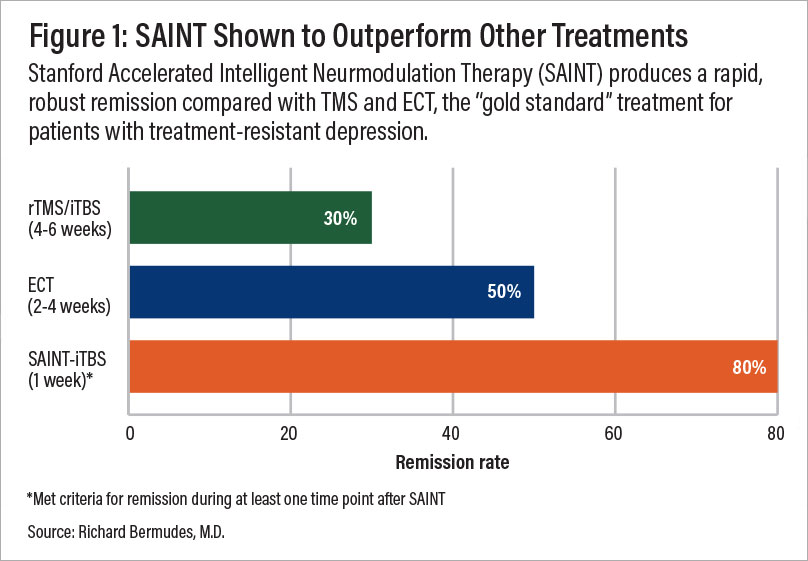
A comparison of remission rates for rTMS/iTBS, electroconvulsive therapy (ECT), and SAINT-iTBS.
The only difference between our treatment and SAINT™ (a trademark licensed to Stanford Medical) is our targeting method. Our target locations are determined by fMRI and our prescribing neuroscientist and physician, rather than their proprietary software.
To improve outcomes for our patients, we include cognitive behavioral therapy (CBT) as part of our treatment. When combined with conventional TMS, CBT improved response and remission rates by ~8% and ~19%, respectively. Additionally, CBT is likely to produce sustained improvement over time once treatment has concluded.
Cost is $9,000-$12,000. Insurance covers standard rTMS (the 6-week protocol) but not the accelerated protocol. Patients under 14 (teens ages 14 to 17 are treated with parental supervision; patients over 65 need a consultation and a doctor visit first), those with a history of seizures, or those with certain metal implants near the treatment site are not candidates.
If you're dealing with treatment-resistant depression and want to find out if you're a good candidate for TMS therapy, you can take our short quiz or call 385-832-6705.
The Emerging PTSD Protocol
Cognitive FX is currently developing a research protocol for TMS as a PTSD treatment. The same fMRI-guided targeting approach and accelerated format used for depression will form the foundation of the PTSD protocol, with the key difference being that the right DLPFC will be the primary treatment target.
This work is in early stages. Patients who participate will be doing so as part of an active research effort. This is not an FDA-approved treatment for post-traumatic stress disorder, and outcomes are still being studied.
For patients who have been through EMDR therapy without sufficient symptom relief, or who are not in a position to engage in trauma-recall talk therapy, this emerging TMS protocol may represent a meaningful alternative among available treatment options.
If you’re interested in receiving TMS for PTSD, fill out our form to see if you may be a good fit for our research protocol.
Conclusion: Established vs. Emerging PTSD Treatments
EMDR therapy is an established, evidence-basedPTSD treatment, and for patients who can engage with it fully, it remains one of the most effective treatment options available. But "can engage with it fully" is not a small qualifier — it rules out a meaningful portion of patients who are too dysregulated, too overwhelmed, or simply unwilling to revisit past trauma and distressing memories in a clinical setting. Therefore, this method is less effective for those with chronic or complex trauma histories.
TMS offers a different path. Brain stimulation addresses brain dysfunction directly, without requiring memory recall or emotional regulation preparation. For treatment-resistant depression and other mental health conditions, the evidence for the efficacy of TMS is extensive, and fMRI-guided protocols produce results well above the standard-of-care benchmark. For post-traumatic stress disorder specifically, TMS is emerging. The research is early, and the protocol is not yet FDA-approved, but the preliminary findings are promising, and the underlying neuroscience is sound.
For patients with both PTSD and depression, those who haven't found sufficient symptom relief through existing treatments, or those who want to understand all available treatment options, it may be worth having a conversation with a qualified mental healthprovider about what's currently available.
Relevant and Cited Research
- American Journal of Psychiatry (2021) — Stanford SAINT trial: doi.org/10.1176/appi.ajp.2021.20101429
- STAR*D study — antidepressant remission rates
- World Health Organization — PTSD treatment guidelines
- American Psychiatric Association — PTSD treatment guidelines
- TMS for PTSD research — PMC12744610
- TMS + comorbid depression in PTSD — PubMed 28278422
- TMS + CPT combination — PubMed 29351885
- TMS in veterans with PTSD + mTBI — PMC10765323
- PTSD-depression comorbidity rates — PubMed 7492257, PubMed 23696449
- Shapiro, F. (2014). The role of EMDR therapy in medicine. The Permanente Journal — PMC3951033
- Schema Therapy, ImRs and EMDR for complex PTSD review — PMC12573552
- EMDR vs. MOSAIC therapy for PTSD (dropout rates, symptom worsening) — PMC10418657