There are many ways in which equestrian athletes of different disciplines sustain concussions. Most commonly, it happens when there’s a fall and a rider is thrown or bucked off their horse, and the symptoms that result can be painful and challenging:
- Difficulty concentrating
- Headaches
- Light and noise sensitivity
- Brain fog
- Fatigue
- Sleep problems
- Anxiety or irritability
For most riders, these symptoms are temporary and dissipate with standard recovery protocols. For some, though, symptoms persist.
Post-concussion syndrome is what happens when concussion symptoms don't clear on the usual timeline and settle in for months or years. It is real, it is physical, and it is far more common among riders than most people realize. Left alone, these symptoms linger rather than fade, and more than half of people treated for a brain injury still report several symptoms a year later. However, that does not make them permanent. Even symptoms that have lasted for years can improve with the right treatment.
This article covers best practices for recovering successfully immediately after an equestrian concussion, what a riding fall does to the brain, why symptoms linger for some riders, and what effective treatment looks like in cases of post-concussion syndrome, including how to return to the saddle once the underlying problem has actually been addressed.
Table of Contents
Note: In published research, 77% of patients treated at Cognitive FX showed meaningful improvement in their post-concussion symptoms. If your symptoms have lasted more than three months, you can get a free case review to find out whether treatment is likely to help you.
Best Practices to Recover Immediately After an Equestrian Concussion
We’ve written extensively about what to do immediately after sustaining a concussion to give yourself the best chance at successful recovery. We’ll summarize here, but read this article for the detailed walkthrough.
For the first two days after a fall, practice relative rest. Avoid strenuous mental and physical activity, but don’t isolate yourself in a dark room all day. Gentle activities like light reading, stretching, or sitting outside are fine as long as they don’t produce a sharp spike in symptoms. Limit exposure to bright lights, loud noises, and crowded environments.
After those first 48 hours, controlled physical and cognitive activity becomes essential. A concussion disrupts normal signaling between neurons, and without appropriate stimulation, the brain may settle into inefficient communication patterns rather than returning to its pre-injury pathways.
The daily recovery routine:
- 30 minutes of cardio: Use a stationary bike or elliptical rather than running, which jostles the head. If symptoms like dizziness flare up, switch to intervals: a minute or two of effort followed by structured breathing (four seconds in, one second hold, six seconds out) until your heart rate settles, then repeat. For equestrians, avoid getting back in the saddle during this phase. The risk of a second impact while the brain is still vulnerable far outweighs the training benefit.
- 30 minutes of cognitive exercise immediately after cardio: Physical exertion produces neurochemicals like BDNF that enhance brain plasticity, so pairing cognitive work with exercise is more effective than doing them separately. Read, have a demanding conversation, or work through a problem that requires sustained attention.
- Calm the autonomic nervous system: A concussion can dysregulate the systems controlling heart rate, breathing, and stress response. Meditation, controlled breathing exercises, yoga, or any genuinely calming activity can help stabilize these functions.
- Limit screen time and maintain normal routines: Reduce time on screens, but don’t withdraw from daily life. Light chores, socializing, and non-screen activities support recovery.
- Return to work or school gradually: Start at roughly 10 hours the first week back, 20 the following week, and build from there. Even if symptoms have resolved, a gradual ramp protects against setback.
- Follow an anti-inflammatory diet: Reduce processed foods and refined sugar, stay well hydrated (aim for half your body weight in ounces of water per day), and add fresh vegetables, fruits, and nuts. Eat regularly throughout the day.
Most concussions resolve within two weeks with this approach. If symptoms persist beyond six weeks, that may indicate post-concussion syndrome, which requires more targeted evaluation and treatment.
What a Riding Fall Actually Does to the Brain
A concussion is caused by the brain moving rapidly inside the skull, not necessarily by the skull striking something. A horse that spooks, stops short, or throws you can snap your head back and forth hard enough to injure the brain even if your head never makes contact with anything. This is the same whiplash mechanism that injures people in car crashes, and it explains why so many riders who "just got the wind knocked out of them" are still struggling later.
Also, you don't have to black out. Most riders who develop lasting symptoms never lose consciousness. In surveyed competitive riders, the most common symptom reported after a fall was not disorientation or memory loss but neck pain, followed by headache and dizziness, the kinds of complaints that are easy to shrug off and ride through.
Neurovascular Coupling Breaks Down
To understand why symptoms persist, you need to know about a brain process called neurovascular coupling. Your neurons rely on nearby blood vessels to deliver oxygen exactly when and where they need it. When a part of the brain gets to work, it “asks” for energy and nutrients, and in a healthy brain that blood supply arrives on time. A brain injury disrupts that signaling. Some regions then receive too little blood flow and can't finish the job they're asked to do, while others receive too much and work inefficiently. This breakdown is now understood to be what drives most persistent post-concussion symptoms.
Picture traffic on a road network. A healthy brain routes signals down the fastest, most direct roads. After an injury, the usual routes are blocked, so the brain detours onto slower side streets to get the same task done. It burns more fuel, takes longer, and tires quickly. That is why a conversation in a noisy barn, or a long ride, can leave you drained in a way that makes no sense to anyone watching.
A standard MRI or CT scan can't see any of this, which is why rider scans often come back normal. Those scans show the brain's structure, but the problem is the underlying dysfunction. A functional MRI measures blood flow while you think, which is how this kind of dysfunction becomes visible.
The Neck Is Part of the Picture
Whiplash doesn't only shake the brain. It also strains the neck, and an injured cervical spine produces headaches, dizziness, and balance trouble that overlap almost exactly with concussion symptoms. This is very important for a rider, because the neck is where your head, eyes, and balance system coordinate to keep your gaze steady while your body moves. When that coordination is off, so is your riding.
The Knock-On Systems
A brain injury often disturbs other systems that keep the body regulated. The three that cause riders the most trouble are the autonomic nervous system, which can lead to dysautonomia and heart-rate and blood-pressure problems such as POTS; the visual and vestibular systems, which govern balance and eye tracking; and the body's hormone regulation. Each one can generate its own cluster of symptoms, which is part of why post-concussion syndrome is so easy to misdiagnose.
Why Riders End Up with Lingering Symptoms More Often Than They Should
Horseback riding carries a risk of head injury that rivals football, rugby, and motor racing. However, unlike those sports, horse riding has no sideline, no team doctor, and a culture that treats falling off and getting straight back on as a point of pride.
That culture has a measurable cost. Among competitive riders surveyed about their history, nearly half had sustained a concussion, and more than half reported a history of head injury. Experience offered no protection. Professionals and amateurs were concussed at almost the same rate. Of the riders who had been concussed, 78% had never been taught anything about head injuries, over half took less than five days off before riding again, and fewer than a third changed anything about how they rode afterward. In most cases, the rider decides for themselves when to get back on, with a medical professional involved less than a third of the time.
The pattern that follows is predictable. A single concussion goes untreated because it didn't seem serious. The rider is back in the saddle within days, before the brain has recovered, and takes another knock. Smaller impacts that never got called concussions accumulate on top. Each injury raises the odds that symptoms will stick, and the effects of repeated concussions compound over a riding career. By the time many riders go looking for real answers, they've been unwell for years. The average patient treated at Cognitive FX was injured about four years before arriving.
Women are also more likely to develop persistent symptoms than men after a concussion, which matters in a sport where most participants are women, and where the symptoms that follow are too often put down to something else.
The Symptoms Riders Miss or Explain Away
Post-concussion symptoms are wide-ranging, and they rarely announce themselves as brain injury. The common ones include:
The trap for riders is that every one of these has a more flattering explanation. Exhaustion becomes "I've let my fitness slip." Trouble following a lesson becomes "I'm just distracted." Breathlessness and a racing heart in the saddle become "I'm out of shape." Low mood becomes "I'm frustrated that I'm not riding well." For an athlete used to pushing through discomfort, explaining symptoms away is almost reflexive.
Exercise intolerance is especially cruel for a rider, because the instinct is to train harder, and training harder makes it worse. The cause isn't deconditioning. It's a brain that can't yet regulate blood flow under load.
Riders also carry a weight that other concussion patients don't. A horse still needs to be ridden, fed, and cared for while you can't do it, which means the guilt of handing your horse to someone else, the worry about its welfare, and the cost of keeping it, stacked on top of whatever your own treatment will cost.
Where Standard Concussion Care Falls Short For Equestrian Athletes
For concussion symptoms that drag on, many clinics add medication to manage headaches or sleep, and the better ones bring in physical therapy, vestibular rehabilitation, vision therapy, and carefully dosed aerobic exercise. These approaches help, and for a lot of patients they're enough.
The problem is that "better" is usually measured by how you feel at rest. You can reach the point where you have no headache sitting in a quiet room, read for a while without trouble, and walk across the yard without getting dizzy, and still be nowhere near ready to ride.
Riding asks the brain to do something far harder than resting. It has to hold your gaze and your balance steady while a thousand-pound animal moves underneath you, track a course and judge distances, and react in a fraction of a second when the horse doesn't do what you expected.
Those demands run directly through the systems a brain injury tends to leave impaired: balance, vision, and the autonomic regulation that keeps you steady under effort. A rider can be "cleared" and still find that the warm-up ring is visually overwhelming, that transitions bring on dizziness, or that reactions are a half-second slow. Going back before those systems are genuinely restored is how riders end up taking the next fall.
| Cleared and symptom-free at rest |
Actually ready to ride |
| No headache in a quiet room |
Stable vision and balance while a horse moves beneath you |
| Can read for a while |
Can track a line, judge distances, and react in a fraction of a second |
| Walks without dizziness |
Holds a still head and sits through transitions, spooks, and sudden stops |
| Comfortable in a calm space |
Tolerates a noisy, visually busy barn and warm-up ring |
| Rests when tired |
Sustains a full ride without a symptom crash afterward |
Standard care tends to quiet symptoms without restoring the neurovascular coupling underneath them. That's the gap, and closing it is what our specialized treatment approach is built around.
How Cognitive FX Treats Equestrian Post-Concussion Syndrome
Cognitive FX treats persistent post-concussion symptoms with an intensive program built around a functional brain scan. The scan, called functional NeuroCognitive Imaging (fNCI), measures blood flow across brain regions while you perform cognitive tasks. It shows which areas are underperforming and which are overworking, and it turns a "normal" scan into a specific map of what's actually wrong. That map is what the week's treatment is built from, and a second scan at the end measures what changed.
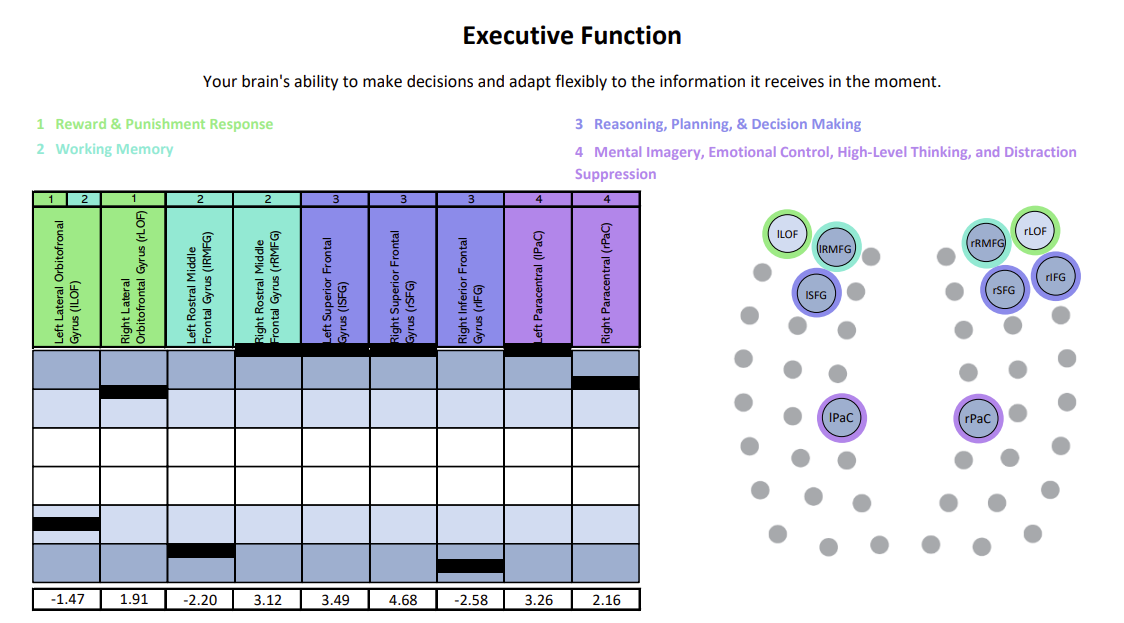
Each chart shows how specific brain regions are functioning compared to a normal brain. The white area represents the normal range, with the center line marking the average. Light and dark blue zones show increasing levels of abnormality. A black line marks the patient’s result for that region—ideally landing within the white. Lines in the light and dark blue zones suggest that region is either hyperactive (blue zones above the white) or hypoactive (blue zones beneath the white). In this example, the patient was experiencing both hypoactivity and hyperactivity within different key regions linked to executive function.
Treatment itself is the EPIC program, a week of multidisciplinary therapy in Provo, Utah. The core principle is simple. Short bursts of cardio increase blood flow and prime the brain with the growth factors it needs to rewire, and therapy delivered in that window does the rewiring. The therapies are chosen from the scan and include:
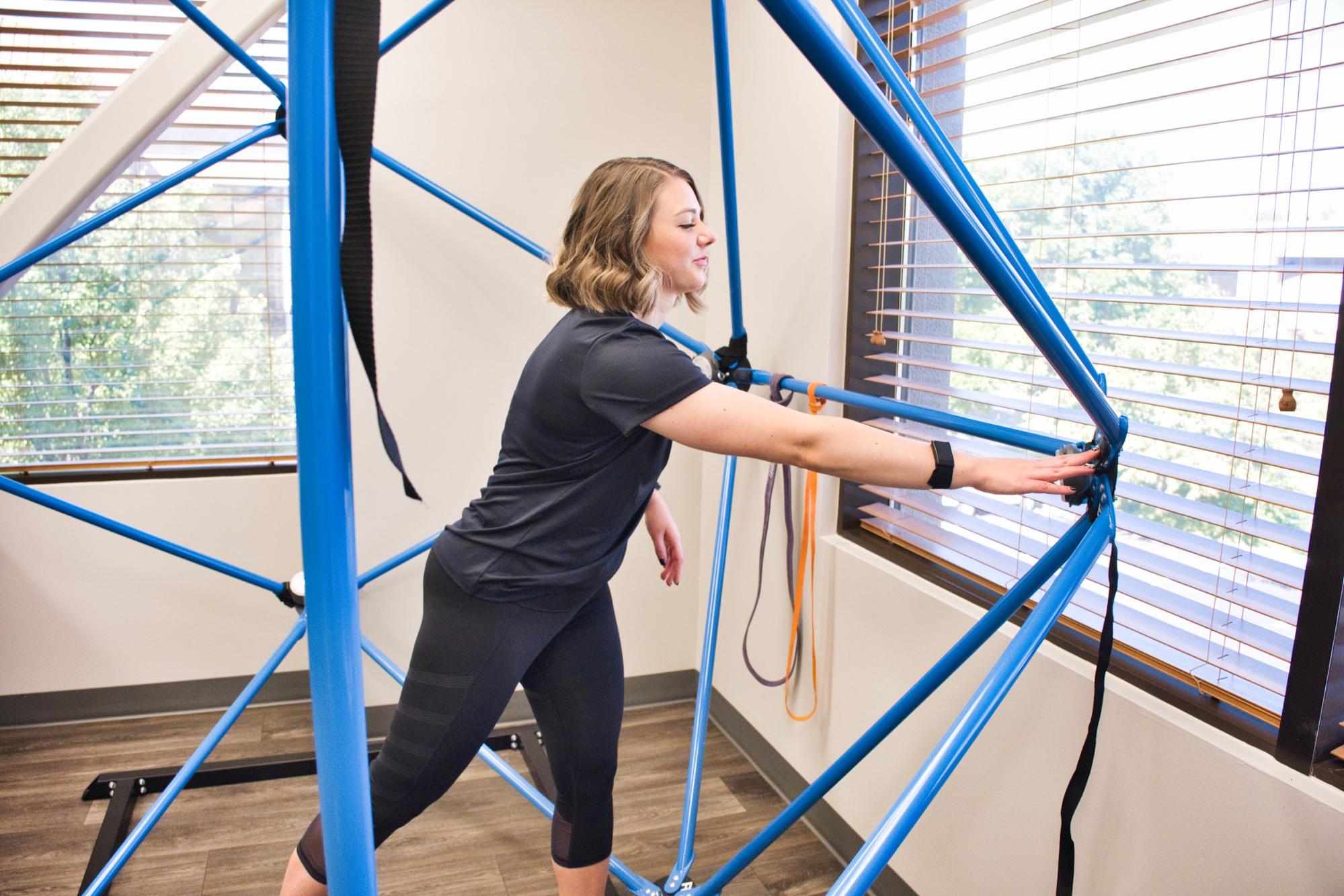
For a rider, that combination happens to target the exact systems riding depends on. The goal throughout is to restore healthy neurovascular coupling rather than to mask the symptoms it produces.
The results are documented. Published research shows 77% of patients experience a meaningful reduction in symptoms, and Cognitive FX is the only post-concussion clinic with third-party validated outcomes. Just as important for riders who have been unwell for years, recovery rates are no different whether the injury happened one year ago or more than a decade ago. The brain keeps its capacity to heal. Individual results vary, and the program is designed for adults whose symptoms have lasted longer than three months and haven't improved with standard care.
If you've been struggling with symptoms for more than three months after a fall from a horse, you don't have to accept that this is simply how things are now. Cognitive FX treats adults whose post-concussion symptoms haven't resolved with standard care, however long ago the injury happened. Book a free consultation to talk through your history and find out whether treatment is likely to help, or take the good-fit quiz to see if you're a candidate.
Returning to Riding After Post-Concussion Syndrome
A return to the saddle works differently once you've treated the root cause. The test now is whether you’ve regained the balance, visual stability, and ability to regulate under exertion that riding requires. Once you have, the next step is to build up your time and effort in the saddle gradually.
Start smaller than feels necessary. Groundwork and short sessions on a calm, familiar horse let your balance and visual systems meet the demands of being around a moving animal again without overwhelming them. Build from there in steps, and treat a return of symptoms as information. It tells you where your current limit sits so you can work just below it, which is how the limit moves.
There is also the part no one examines on a scan. After a bad fall, a lot of riders lose their nerve, and that fear is real and separate from the brain injury itself. It deserves to be taken as seriously as the physical recovery, and it tends to ease the same way confidence is always rebuilt: through small successes that prove to you the ground is steady again.
Some riders face a harder question, which is whether to keep riding at all. Repeated head injuries carry real cumulative risk, and only you can weigh that against what riding means to you. The decision is a fairer one when you make it from recovery, with a brain that's working again and a clear head to choose with, rather than from the fog of ongoing symptoms.
Relevant and Cited Research
- Kuhl HN, Ritchie D, Taveira-Dick AC, Hoefling KA, Russo SA. Concussion History and Knowledge Base in Competitive Equestrian Athletes. Sports Health. 2014;6(2):136–138. https://pmc.ncbi.nlm.nih.gov/articles/PMC3931338/
- Allen MD, Fong AK. Neurovascular Coupling: A Unifying Theory for Post-Concussion Syndrome Treatment and Functional Neuroimaging. Journal of Neurology and Neurophysiology. 2017;8(6):454. https://www.iomcworld.org/open-access/neurovascular-coupling-a-unifying-theory-for-postconcussion-syndrome-treatment-and-functional-neuroimaging-2155-9562-1000454.pdf
- Machamer J, Temkin N, Dikmen S, et al. Symptom Frequency and Persistence in the First Year after Traumatic Brain Injury: A TRACK-TBI Study. Journal of Neurotrauma. 2022;39(5–6):358–370. https://pmc.ncbi.nlm.nih.gov/articles/PMC8892966/
- Griesbach GS, Hovda DA, Molteni R, Wu A, Gomez-Pinilla F. Voluntary exercise following traumatic brain injury: brain-derived neurotrophic factor upregulation and recovery of function. Neuroscience. 2004;125(1):129–139. https://pubmed.ncbi.nlm.nih.gov/15051152/
Further Reading