Published peer-reviewed research shows that Cognitive FX treatment leads to meaningful symptom reduction in post-concussion symptoms for 77% of study participants. Cognitive FX is the only PCS clinic with third-party validated treatment outcomes.
Old Head Injury Symptoms Years Later: 37 Signs + Self-Check
35:27
Yes, a head injury can cause problems years later. In a large US study of people with a mild head injury and a normal CT scan, 56% had not fully recovered six months later, and some people first notice problems months or years after the injury. The most common long-term symptoms are headaches, fatigue, dizziness, brain fog, memory problems and mood changes, and most of them can be treated.
Medical note: this article and the self-check below are for education only. They are not a diagnosis and cannot replace a visit with your doctor.
Free 2-minute self-check
Hit your head years ago and still not right?
Answer 4 questions to see whether your symptoms fit the pattern of an old head injury, and what to do next. Your answers stay on this page.
Educational only. This check is not a diagnosis.
Your result
Your answers are consistent with lasting symptoms from a head injury.
You picked 0symptoms that affect . Symptoms in more than one area at once are a common pattern after a head injury. You said they limit you most days, so it is worth getting a clear answer. Our team can review your answers and tell you whether we can help.
A few questions from home. About 10 minutes. Our team reviews your answers to see if we can help. It is not a medical appointment.
Free video consult. If we can help, you pick a time to talk through your plan and the price.
Brain scan and treatment in Provo. Scans are $1,500 and a week of treatment is $13,000, scans included.
Prefer to talk first? Call (385) 375-8590. We are out of network and don't bill insurance, but we give you the information to submit a claim yourself. CareCredit, FSA and HSA are accepted. Under 18? Call us to ask what options fit.
This self-check is for education only and is not a diagnosis. It cannot replace a visit with a healthcare provider, so talk with your doctor about your results. In an emergency, call 911.
Your result
Your injury is recent, so start with your doctor.
Many people recover from a concussion in the first few months. If you still have symptoms three months after the injury, come back and take this check again.
If a symptom gets suddenly worse, or you notice anything on the emergency list below, get urgent care.
This self-check is for education only and is not a diagnosis. It cannot replace a visit with a healthcare provider, so talk with your doctor about your results. In an emergency, call 911.
Your result
You didn't pick any of the most common symptoms.
The full list of 37 symptoms below includes less common ones, like ringing in the ears, feeling too hot or cold, or a racing heart when you stand. See the full list.
This self-check is for education only and is not a diagnosis. It cannot replace a visit with a healthcare provider, so talk with your doctor about your results. In an emergency, call 911.
Your result
Your symptoms may have another cause.
Symptoms that started before the injury and haven't changed since are less likely to come from it. Thyroid problems, sleep disorders, migraine and mood disorders can cause many of the same symptoms, so start with your doctor.
Not sure how your symptoms line up with your injury? Call (385) 375-8590 and talk it through with our team.
This self-check is for education only and is not a diagnosis. It cannot replace a visit with a healthcare provider, so talk with your doctor about your results. In an emergency, call 911.
Why can head injury symptoms show up or last years later?
A head injury, even a "mild" concussion, can disrupt neurovascular coupling (NVC): the way blood vessels deliver oxygen to neurons exactly when and where they need it. When NVC is off, affected brain regions don't get the right amount of oxygen at the right time. They struggle with tasks like forming memories, processing what you see, or regulating emotions.
In our 2026 data from 6,654 people who asked us for help with a head injury, 22% were more than five years past their most recent injury, and 12% were more than ten years past it.
The brain is good at compensating. Healthier regions pick up the slack and route around the problem, and you might function reasonably well for years this way. But those workarounds have limits. Stress, aging, hormonal changes or another minor injury can tip the balance, and symptoms you barely noticed become impossible to ignore.
How symptoms can appear years later
The brain works around an injury until it can no longer keep up
Simplified sequence
An injury disrupts blood flow to some brain regions
Healthier regions take over part of their work
You get by for months or years
Stress, aging, illness or another bump overloads the workaround
Symptoms appear or get worse
Simplified illustration of the compensation model described in this section.
This is why some people have symptoms right after an injury while others don't notice problems until years later. It also explains why symptoms can come and go, or slowly get worse.
Other causes of lasting symptoms
NVC problems rarely act alone. An old head injury can also affect:
The autonomic nervous system (dysautonomia). This system runs heart rate, blood pressure, digestion and body temperature. When it's thrown off, you can get symptoms that seem unrelated to your head, like a racing heart when you stand.
The vestibular system. When the balance system is damaged, you might have dizziness, vertigo, motion sensitivity or poor coordination.
Vision. Visual processing is spread across the brain, so trouble with eye tracking, focusing, depth perception and light sensitivity is common after head trauma.
How long ago were the people who contact us injured?
Many people who reach out to us were hurt years earlier. These numbers come from 1,447 people who started our intake paperwork for a head injury from January to September 2026:
Cognitive FX intake data, 2026
Time since injury when people first contacted us
1 in 5were injured 5 or more years earlier
1 in 8were injured 10 or more years earlier
56%reported more than one head injury
Source: 1,447 people who started the Cognitive FX intake form for a head injury, Jan 1 to Sep 24, 2026, including people who did not finish it. Time since injury compares the injury date they entered with the date they filled out the form.
Patient story
Fatigue, noise and light sensitivity and trouble concentrating, eight years after two accidents
2 min 28 sec, with captions.
Simone was in a car accident and fell from her horse in the same month in 2018. Her symptoms kept her at home. She traveled from the Netherlands to Cognitive FX and recorded this during her treatment. Her training continues at home for the next six months to a year.
Before
"Totally overwhelmed, couldn't stand any noise or light."
The treatment
"It's full, but it's doable."
Now
"I really feel like I'm on again."
Simone is a real patient describing her own experience. Individual experiences vary.
What are the 37 symptoms of an old head injury?
The effects of a head injury reach far beyond headaches. These are the 37 symptoms we see most often in patients with old head injuries, grouped by type.
Symptom list
The 37 symptoms we see most from old head injuries
Physical (20)
Headaches
Fatigue
Dizziness or vertigo
Balance problems
Sleep problems
Light sensitivity
Noise sensitivity
Vision problems
Exercise intolerance
Nausea
Heart rate changes
Blood pressure changes
Changes in taste or smell
Feeling too hot or too cold
Neck and jaw tension
Digestive problems
Ringing in the ears (tinnitus)
Exaggerated startle response
Motion sensitivity
Weight or appetite changes
Thinking and memory (8)
Brain fog
Memory problems
Trouble concentrating
Slow processing speed
Trouble finding words
Getting lost easily
Trouble making decisions
Trouble reading
Mood and emotions (9)
Depression
Anxiety
Irritability or anger
Mood swings
Feeling overwhelmed
Social withdrawal
Tearfulness
Impulsiveness
Feeling anxious without anxious thoughts
Having a symptom on this list does not mean it comes from a head injury. Many have other causes.
Physical symptoms
Headaches are one of the most common lasting symptoms. They can be constant dull aches, tension-type headaches or full migraines, and many patients notice they get worse with mental effort, stress or screen time.
Fatigue goes beyond normal tiredness. You might wake up unrested no matter how long you sleep. Mental tasks that used to be easy drain you, and by afternoon you're running on empty.
Dizziness and balance problems range from occasional unsteadiness to constant vertigo. Some patients feel the room spin. Others notice they're clumsier than before, bumping into doorframes or catching themselves on stairs.
Sleep problems include trouble falling asleep, waking often, sleeping too much or never feeling rested. Poor sleep then makes every other symptom worse.
Light and noise sensitivity can make fluorescent lights, busy restaurants or normal conversation hard to tolerate.
Vision problems include blurry or double vision, trouble focusing, eye strain and trouble tracking moving objects. Many patients never connect these to an old head injury.
Exercise intolerance means activity sets off symptoms instead of helping. Your heart races, you get lightheaded, or your headache spikes. That's hard to accept if exercise used to be how you relieved stress.
Other physical symptoms include blood pressure and heart rate changes, nausea, changes in taste or smell, feeling too hot or too cold, neck and jaw tension, digestive problems, ringing in the ears, motion sensitivity, weight or appetite changes and an exaggerated startle response.
Cognitive symptoms
Brain fog feels like thinking through molasses. Your thinking is slow and cloudy, and simple tasks take enormous effort.
Memory problems often affect both short- and long-term memory. You walk into a room and forget why, lose track of yesterday's conversations, or can't find names and words that should come easily.
Trouble concentrating makes long tasks, reading and group conversations hard to follow. Your mind wanders constantly.
Slow processing speed means everything takes longer: understanding questions, forming answers and finishing tasks that used to be automatic. Other people can mistake this for a lack of intelligence when it comes from an injured brain.
Getting lost in familiar places, trouble making decisions (from what to eat for lunch to major life choices) and trouble reading are also common.
Emotional and mood symptoms
Depression after a head injury often has a neurological cause: disrupted brain chemistry and function, on top of whatever is happening in your life.
Anxiety can appear for the first time after an injury or get much worse. Some patients have panic attacks. Others live with a low-level dread they can't explain.
Irritability, anger and mood swings can seem out of proportion to the situation. You snap at people you love over small things, which often brings strain and shame.
Feeling overwhelmed by situations you used to handle, pulling away from friends and hobbies, crying more easily and acting on impulse are also common.
Feeling anxious without anxious thoughts is when your body has the signs of anxiety (racing heart, tension, restlessness) but your mind isn't worried about anything. This often points to autonomic nervous system dysfunction.
If you are having thoughts of suicide, call or text 988 to reach the 988 Suicide and Crisis Lifeline. You matter, and you can get better.
How do you know if your symptoms are from an old head injury?
Many of these symptoms overlap with other conditions, like depression, anxiety, thyroid problems, sleep disorders or normal aging. These clues point toward an old head injury:
Your symptoms started or got worse after a head injury, even if there was a delay of months or years.
More than one area is affected. Problems in two or three areas (physical, thinking and mood) suggest a brain injury more than a problem in one area does.
Mental effort makes things worse. Headaches, fatigue or brain fog that build after concentrating, reading or screen work are a hallmark of post-concussion problems.
You've had more than one concussion. Each injury raises the risk of lasting symptoms, even when each one seemed minor.
Old head injury or something else?
Normal aging usually brings slow, mild changes. Symptoms from an old head injury are often stronger, affect several areas and may start suddenly.
Depression or anxiety alone doesn't explain physical symptoms like headaches, dizziness or exercise intolerance. Mood symptoms caused by a brain injury also often respond only partly to standard treatment.
Early dementia tends to get steadily worse and mainly affects memory. Post-concussion symptoms can stay stable for years, affect attention and processing speed more than memory storage, and can improve with treatment.
Is my memory getting worse from an old concussion or from aging?
You usually cannot tell on your own, and both can play a part. A clinician looks at the timeline (a change soon after the injury, or one that crept in later), asks someone who knows you well, and compares your memory and attention test scores with people your age. Blood tests for thyroid and vitamin B12 look for treatable causes (Atri et al., Alzheimer's & Dementia, 2025), as does a review of sleep, mood and medications. In 15,764 adults aged 50 to 90, those reporting a past mild head injury scored slightly lower on attention, but their scores did not fall faster over four years (Lennon et al., Journal of Neurotrauma, 2023). See a doctor if memory is worsening quickly.
How do you test for a TBI years later?
No single test can confirm that symptoms come from an old injury. A specialist puts together your history, your symptom pattern and several kinds of testing. Standard MRI and CT scans show the brain's structure, so they are often normal after a concussion, which is why many patients are told nothing is wrong.
What should testing cover years after a head injury? In this 10-minute video, Dr. Alina Fong explains why scans are usually normal after a concussion and gives a checklist to bring to your next appointment: headache and neck, mood, sleep, balance and eye movements, and memory.
Testing years after an injury
What each test can show
Test
What it can show
Your history
When you were hurt, what changed afterward, and any other concussions. Old medical, school or military records can help date an injury.
CT or MRI
Bleeding, fractures, bruising and scarring. After a concussion these scans are often normal, even when symptoms are real.
Neuropsychological testing
Memory, attention, processing speed and problem solving, compared with people your age.
Vestibular and eye-movement exams
Balance, eye tracking and focusing problems behind dizziness, reading trouble and motion sensitivity.
Autonomic testing
How your heart rate and blood pressure respond when you stand, for example on a tilt table.
Hormone blood tests
Pituitary problems that can cause fatigue, weight changes and low mood.
Functional brain imaging (fNCI)
Which brain regions are underactive or overactive while you do thinking tasks.
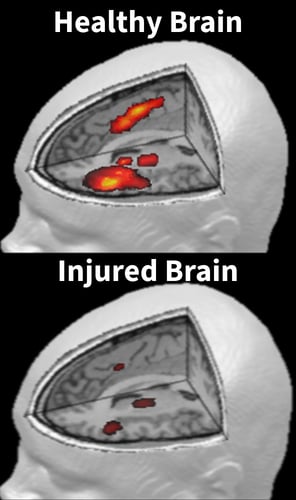
At Cognitive FX, we use a functional brain scan called fNCI (functional neurocognitive imaging). You do thinking tasks during an fMRI scan, and the results show which brain regions are underactive or overactive. Scans are $1,500, and if you go on to treatment, the scan fee counts toward the program.
Functional MRI activation in a healthy brain (top) and in a patient after a concussion (bottom).
Want to know what a scan would show for you? Our team can review your case for free and tell you whether we can help.
Most lasting symptoms are not dangerous, but a few problems after a head injury need fast medical care, and moderate to severe TBI can affect health for life.
Delayed bleeding. A chronic subdural hematoma is a slow bleed between the brain and its covering that can build for weeks after a bump that seemed minor. It mostly affects adults over 60 and people on blood thinners. Signs include a headache that won't go away, confusion, trouble walking and weakness on one side.
Seizures. Seizures after a head injury usually start in the first few years, but after a severe injury new ones can begin much later. In one study of severe TBI survivors, 25% had developed seizures by five years after the injury and 32% by fifteen years.
Long-term health after a serious injury. Among people 16 and older who went through inpatient rehabilitation for a moderate or severe TBI, the CDC reports that five years later 22% had died, 30% were worse, 22% were the same and 26% had improved. Those numbers describe hospital-treated injuries, not a typical concussion.
Is it permanent brain damage?
Not always. Many lasting symptoms come from brain regions that aren't working together well, rather than from tissue that is gone. That kind of dysfunction can improve with targeted treatment, even years later.
Get emergency care if you notice
A sudden, severe headache, especially the worst of your life
A new seizure
Sudden weakness or numbness on one side of the body
Sudden trouble speaking or understanding speech
Sudden vision loss or double vision
Passing out
New or sudden confusion
Repeated vomiting
Clear fluid draining from the nose or ears
These can signal a new problem that needs care right away, separate from your old injury.
See a specialist if
Your symptoms are getting worse over time instead of staying the same
You have new symptoms that weren't there before
Your symptoms get in the way of work, relationships or daily life
Medication, rest or general therapy hasn't helped
You've been told nothing is wrong, but you know something isn't right
Who is most at risk for long-term symptoms?
These factors make it more likely that symptoms last or appear later:
More than one concussion. The risk adds up with each injury, even when each seemed mild.
A more severe first injury. Moderate and severe TBI carry the highest risk, but mild injuries can also cause lasting symptoms.
Loss of consciousness or memory loss at the time of the injury. Their absence doesn't rule out lasting problems.
Age. Adults tend to recover more slowly than children and teens.
Existing conditions, such as anxiety, depression, ADHD, migraines or earlier brain injuries.
No early treatment. Many people with "mild" injuries were told to rest and wait, without active treatment.
Contact sports. Athletes with years of repeated head impacts face higher long-term risks.
Can a childhood head injury cause problems years later?
Yes. A child's brain is still developing, so some effects of an injury only show up as school, work and life ask more of it. If you had a fall or sports hit as a child that was never checked, tell your doctor about it. Read more about the long-term effects of childhood head injuries.
Does an old head injury raise the risk of dementia?
A serious one may. In a study of World War II veterans whose head injuries were documented in military records, a moderate head injury was linked to about 2.3 times the risk of Alzheimer's disease and a severe injury to about 4.5 times the risk. Results for mild injuries were inconclusive. Higher risk is not a diagnosis, and symptoms that stay stable for years are more typical of post-concussion problems than dementia.
What treatment works years after a head injury?
Recovery is possible years or even decades after a head injury. The brain keeps its ability to form new connections throughout life, so treatment works best when it targets exactly what's wrong.
Symptoms for three months or more? Our team can review your case for free and tell you whether we can help.
Medication can ease symptoms without changing the brain dysfunction behind them. Painkillers help headaches but don't fix their cause, and antidepressants may take the edge off mood symptoms without resolving them.
Rest and wait was the standard advice for years. The current international concussion consensus recommends only relative rest for the first two days, then light activity, and a referral to a concussion specialist when symptoms last longer than four weeks. Indefinite rest doesn't help the brain recover. It needs the right challenges.
One specialist at a time means a neurologist for headaches, a psychologist for mood and a vestibular therapist for dizziness, each working alone. That approach misses how connected these symptoms are.
Common myths that keep people from treatment
"A mild injury can't cause lasting symptoms." Any head injury can disrupt NVC, whether it's a "mild" concussion or a skull fracture, and loss of consciousness isn't required.
"If your scan is normal, nothing is wrong." Structural MRI and CT can show bleeding and bruising, but they can't show NVC problems. That takes functional imaging.
"It's too late." Patients with severe TBI are often told to expect little more once they can manage daily basics. They do have more limits than people with mild injuries, but many keep improving years later. Read about five patients who made progress after serious injuries.
What works: treatment that targets your brain
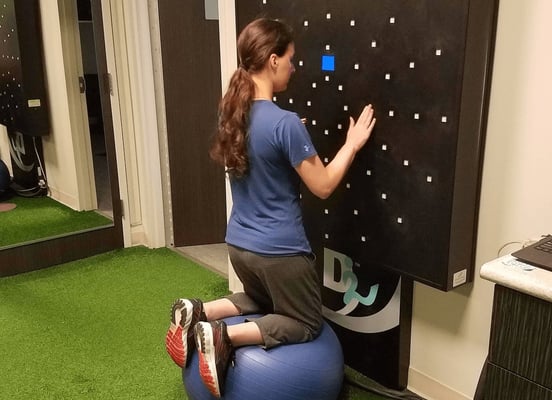
The quick response times needed for Dynavision challenge the thalamus, a brain region Olivia needed to re-engage.
We start with an fNCI scan to see which brain regions are underperforming and which are overcompensating. Then our EPIC treatment program combines therapies matched to your scan and symptoms:
Neuromuscular therapy: targeted exercise that improves blood flow and NVC and prepares the brain for cognitive work.
Cognitive therapy: exercises that make affected regions work again instead of relying on workarounds.
Sensorimotor therapy: retrains the links between what you sense and how you move, for balance, coordination and dizziness.
Vision therapy: for eye tracking, focusing and visual processing problems.
Occupational therapy: turns gains into real-life function.
Psychological support: for the emotional weight of living with lasting symptoms and for mood changes caused by the injury.
These therapies are combined throughout each treatment day, and the mix is adjusted to your scan results and symptoms. Most patients complete treatment in one week. In an independent study by Amsterdam UMC and UMC Groningen, 77% of the 52 patients measured six months after treatment had a meaningful reduction in symptoms. The study was observational, not randomized, and individual results vary.
Before treatment
After the treatment week
One patient's fNCI severity index before and after treatment. Lower is better. Individual results vary.
Sam Gray came to us three decades after his traumatic brain injury. Treatment pushed his brain to use the right regions instead of the workaround pathways it had built. In his words:
"I wasn't using the correct part of my brain for word retrieval and memory. The exercises were forcing my brain to use the correct parts. Doing that is very difficult when you haven't used those parts of your brain in 33 years!"
Recovery continues after you leave. You go home with exercises and strategies to keep improving, and many patients report more progress in the weeks and months after treatment.
What can you do at home in the meantime?
Protect your head. Wear a helmet for biking and skiing, and fix fall hazards at home.
Keep a steady sleep schedule in a cool, dark room, with screens off for an hour before bed.
Manage stress with whatever works for you: gentle exercise, time outside, meditation or creative work.
Build exercise slowly. If activity triggers symptoms, work with someone who knows how to raise your tolerance without flares.
Limit alcohol, which worsens thinking problems and sleep. Many patients tolerate much less than before.
Pace yourself. Take breaks before symptoms spike so you can do more over the whole day.
Find people who get it, through a brain injury support group, an online community or one or two people who believe you.
What happens next
From a few questions to a treatment week
A few questions from homeAbout 10 minutes. Our team reviews your answers to see if we can help. It is not a medical appointment.
Free video consultIf we can help, you pick a time to talk through your plan and the price.
One week in Provo$13,000 for a week of daytime treatment, with brain scans before and after included. Start dates are usually about six weeks out.
Home program and follow-upYou leave with a plan to keep going at home, and our team follows up after your week.
For adults whose symptoms have lasted three months or longer, including injuries from decades ago. Under 18? Call (385) 375-8590 to ask what options fit. We don't bill insurance, but we give you the information to submit a claim yourself. CareCredit, FSA and HSA are accepted.
Frequently asked questions about old head injury symptoms
Can a head injury cause problems years later?
Yes. Symptoms can last for years or first appear long after the injury. In the TRACK-TBI study, which followed patients from 18 US trauma centers for five years, people with a mild TBI were less likely than people with other injuries to make a complete functional recovery, and the gap seen at one year was still there at five years.
How long after a head injury can symptoms appear?
Symptoms can start right away, over the following days or weeks, or months to years later. Delayed symptoms often appear when stress, aging, illness or another injury overloads the ways the brain has been compensating. There is no cutoff after which a symptom can't be related to an old injury.
Can old concussion symptoms come back after an illness, surgery or stress?
They can, but research has not yet shown how often or why. No study we know of has tracked people with an old concussion through a later illness, surgery or major stress. When 917 people with a mild brain injury were followed for up to seven years, 21% declined on at least one measure of thinking, mood or daily function, compared with 15% of people with other injuries (Brett et al., Neurology, 2023). After a stroke, old deficits can return briefly during infections, poor sleep or stress (Topcuoglu et al., JAMA Neurology, 2017). A returning symptom can also have a new cause, so see a doctor, and get urgent care for a sudden severe headache, new weakness or confusion.
Can you have a brain injury and not know it?
Yes. Many people never lose consciousness, never see a doctor, and don't connect later problems to a fall, sports hit or car accident. A childhood injury can go unnoticed until school, work or parenting demands more of the brain.
Can post-concussion syndrome be cured?
Many people improve a great deal with the right treatment, and some return to how they felt before the injury. Results vary from person to person, and improvement is possible years after the injury.
Can repeated head injuries cause problems even if each one seemed minor?
Yes. Each concussion raises the risk of lasting symptoms, and repeated hits, even without a diagnosed concussion, can add up over time. Read more about the effects of multiple concussions.
What type of doctor should I see for symptoms from an old head injury?
Start with a doctor who treats concussion and brain injury: a neurologist, a physiatrist (rehabilitation physician) or a neuropsychologist. A clinic that treats physical, thinking and mood symptoms together usually covers more ground than one specialist at a time. See which brain injury doctor to see.
Is it too late to get treatment for an old head injury?
No. We have treated patients whose injuries happened decades earlier, including Sam Gray, who came to us 33 years after his brain injury. Earlier treatment can be faster, but the brain can still change years later. Of the people who started our intake for a head injury in 2026, about 1 in 5 had been injured five or more years earlier.
How much does treatment for an old head injury cost at Cognitive FX?
Brain scans are $1,500 and a week of treatment is $13,000, with scans before and after included. CareCredit, FSA and HSA are accepted. We are out of network and don't bill insurance, but we give you the information to submit a claim yourself.
Sources
Madhok DY, et al. Outcomes in patients with mild traumatic brain injury without acute intracranial traumatic injury. JAMA Netw Open. 2022. Link
Nelson LD, et al. Functional recovery, symptoms, and quality of life 1 to 5 years after traumatic brain injury. JAMA Netw Open. 2023. Link
Pituitary dysfunction following traumatic brain injury: clinical perspectives. Neuropsychiatr Dis Treat. 2015. Link
Pease M, et al. Risk factors and incidence of epilepsy after severe traumatic brain injury. Ann Neurol. 2022. Link
Centers for Disease Control and Prevention. About moderate and severe TBI. 2024. Link
Plassman BL, et al. Documented head injury in early adulthood and risk of Alzheimer's disease and other dementias. Neurology. 2000. Link
Patricios JS, et al. Consensus statement on concussion in sport: the 6th International Conference on Concussion in Sport, Amsterdam, October 2022. Br J Sports Med. 2023. Link
Concussion in sport: recommendations from the 6th International Conference on Concussion in Sport. Am Fam Physician. 2024. Link
van Doorn et al. Cognitive FX-behandeling voor aanhoudende klachten na een hersenschudding: observatie van verandering in functioneren. Tijdschrift voor Neuropsychologie. 2024. Link
Cognitive FX intake data, Jan 1 to Sep 24, 2026 (1,447 people who started the head injury intake form).
Alina Fong, Ph.D. is a clinical neuropsychologist and the Clinical Director and Co-Founder of Cognitive FX. She earned her Ph.D. in Clinical Neuropsychology with an emphasis in Neuroimaging from Brigham Young University, where she received the American Psychological Association Division 40 Graduate Student Research Award for her neuroimaging research. Dr. Fong has over 17 years of clinical experience treating traumatic brain injury, beginning with her work at the VA Salt Lake City Healthcare System and Utah Valley Regional Medical Center, where she directed the neurotrauma rehabilitation and sports concussion clinics. She developed the EPIC Treatment protocol and has personally overseen treatment for nearly 8,000 brain injury patients, including professional athletes from the NFL, NHL, and Olympics. She serves as Vice President of the Brain Injury Alliance of Utah, sits on the board of the United States Brain Injury Alliance, and advises PINK Concussions. Dr. Fong has authored peer-reviewed research on functional MRI and concussion treatment and has presented at over 60 medical conferences, including the Federal Interagency Conference on TBI and the American Medical Society for Sports Medicine.
Related Posts
Concussion, TBI, and Hypoxic Brain Injury Recovery | Patient Guide
Brain injury recovery is hard. The severity of your injury, which parts of your brain were affected, and how they were affected, all factor into things such as how much you can recover and how long...
Head injuries vary wildly in severity. You could suffer anything from debilitating brain damage to a few days of feeling “off” before returning to normal. You might suffer a moderate traumatic brain...
When someone you love sustains a traumatic brain injury (TBI) or concussion, your whole world can change. You are launched into a world of uncertainty about the injury, recovery, and, perhaps, even...
Recovering from a traumatic brain injury (TBI) often means dealing with physical symptoms, such as headaches, balance issues, weak muscles, and vision problems. These symptoms can affect every aspect...
Between 80,000-90,000 people who suffer traumatic brain injuries (TBIs) each year develop long-term disabilities related to their TBI. Many others suffer from a variety of long-term, problematic...
Quick Facts: Up to 90% of traumatic brain injury patients experience some form of visual dysfunction. Vision therapy achieves success rates of 85-100% for common post-concussion vision issues like...
Published peer-reviewed research shows that Cognitive FX treatment leads to meaningful symptom reduction in post-concussion symptoms for 77% of study participants. Cognitive FX is the only PCS clinic with third-party validated treatment outcomes.



 The quick response times needed for Dynavision challenge the thalamus, a brain region Olivia needed to re-engage.